
Khaki Campbell
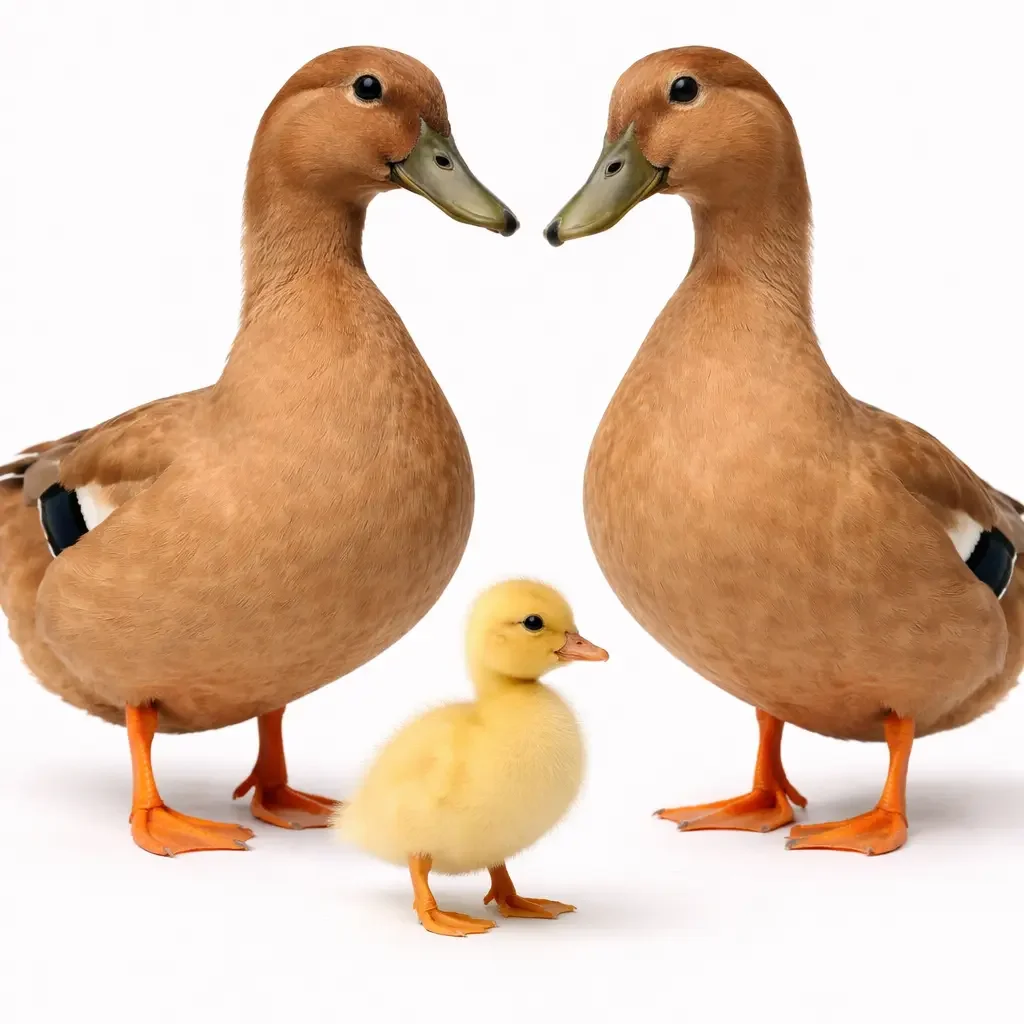
The Khaki Campbell Duck is the world's premier egg-laying domestic duck, and the standard against which every other laying breed is measured. Created in late nineteenth-century England by a woman named Adele Campbell who wanted a duck capable of outperforming every layer she had ever kept, the Khaki Campbell went on to achieve exactly that and more. Its egg production regularly exceeds the most efficient egg-laying chicken breeds. Its adaptability to environments ranging from arid desert heat to frozen northern winters is documented across five continents. It is the only duck breed in the domestic duck directory created by a woman, and it is named for the color of the British army uniforms that its khaki plumage reminded its creator of when she achieved the final Penciled Runner cross that fixed the color. For the Midwest homesteader whose primary goal is egg production, the Khaki Campbell is not a recommendation. It is the answer.
Quick Facts
Class: Lightweight
Weight: Drakes 4.5 to 5.5 pounds; hens 3.5 to 4.5 pounds
Egg Production: 250 to 340 large white eggs per year in quality flocks; average across all strains typically 250 to 300
Egg Color: White; occasionally cream or very pale green-tinted
Egg Size: Large; 75 to 85 grams per egg
Primary Purpose: Egg production; dual purpose
Temperament: Active, energetic, high-strung, nervous; social within the flock but requires patience for individual handling
Brooding: Poor; broodiness selectively bred out in favor of sustained laying; incubator or surrogate broody required
Conservation Status: Watch (The Livestock Conservancy)
APA Recognition: 1941; Khaki variety only recognized in the United States
Country of Origin: United Kingdom (Gloucestershire, England)
Year Developed: Original Campbell introduced to public 1898; Khaki variety established 1901; standardized 1926
Lifespan: 8 to 10 years
Image Section
Feature image: Khaki Campbell drake showing dark olive-green head and warm khaki bodySecondary image: Khaki Campbell hen in full khaki-brown plumage foraging on pastureThird image: Khaki Campbell flock showing the uniformity of khaki coloration
Breed Overview
Adele Campbell began keeping ducks around 1887 in Uley, a small village in Gloucestershire, England. She was not a commercial producer but a homesteader's homesteader: a woman who wanted ducks that would consistently produce for her family across both eggs and meat. Her foundational breeding cross was a Fawn and White Indian Runner hen, selected for her remarkable individual laying performance and documented in Lewis Wright's contemporaneous poultry records as a bird that produced 195 eggs in 197 days, against a Rouen drake. She later crossed the offspring with a wild Mallard drake to improve meat flavor. The resulting birds, first shown to the public in 1898, were well-regarded but had an unremarkable, somewhat Mallard-like color.
To capitalize on the buff-colored poultry fad sweeping early twentieth-century Britain, Campbell crossed her original ducks back with Penciled Runner ducks. The resulting color, a warm sandy brown that fell slightly off the buff she was aiming for, reminded her of the British army uniform. She named the new color variety Khaki, and in 1901 the Khaki Campbell was introduced to the British poultry community. The name, combining the family name with the military color, became one of the most memorable breed identifications in all of domestic waterfowl.
The breed's laying performance attracted immediate attention. By 1901 it was documented as averaging 200 to 250 eggs per year, remarkable numbers that exceeded anything available in domestic ducks at the time and rivaled the best laying chicken breeds. The Khaki variety was formally standardized in Britain in 1926. The White Campbell variety was developed by Captain F.S. Pardoe in 1924 and standardized in 1954. The Dark Campbell, developed by H. Humphreys of Devon, was also standardized in 1954 and designed specifically as a sex-linked crossing tool: Dark Campbell crossed with Khaki Campbell drakes produces day-old ducklings that can be sexed by down color.
The breed reached the United States in 1929 through importation by Perry Fish of Syracuse, New York, and was recognized by the American Poultry Association in 1941. For several decades it remained relatively obscure in American homesteading, held back by a preference for the larger and faster-growing Pekin in commercial and semi-commercial contexts. Two events changed this in the 1970s: the back-to-the-land movement that drove renewed interest in productive small livestock breeds, and the surge of Asian immigrant populations following the Vietnam War, as duck egg consumption is deeply embedded in East and Southeast Asian culinary traditions. A productive strain import in 1977 further improved available American stock, and Khaki Campbell numbers in the United States grew dramatically through the 1980s and beyond.
Plumage and Appearance
The Khaki Campbell's plumage is understated by the standards of the domestic duck world but visually appealing in its warm, uniformly satisfying coloration. The khaki color is a sandy, warm brown ranging from pale buff-tan to a richer, deeper brown across the body, with slight variation between individuals and between sexes.
The drake carries a darker head with an olive-green sheen that echoes the Mallard ancestry without the Mallard's bright iridescence or white collar. The body is a warmer khaki-brown with gray-brown back and dark tail coverts. The bill is dark greenish-black. The legs and feet are dark orange to brownish-orange.
The hen is a more uniform, all-over warm brown with slightly darker head and neck coloring than the body and a lighter, orange-brown bill. Both sexes lack the bold contrasting patterns of the Rouen, Saxony, or Buff Orpington, presenting instead as quietly attractive, well-integrated birds whose appeal is more in the harmonious warmth of their coloring than in visual drama.
Drakes can be distinguished from hens by the darker, more olive-green head and darker bill, alongside the characteristic single curled tail feather at maturity. Hens are more uniformly colored and carry the straight tail.
The breed is lightweight and somewhat streamlined compared to heavyweight duals, with a moderately upright carriage that reflects the Indian Runner ancestry without the extreme vertical stance of pure Runner lines. The body is held at an angle between the nearly horizontal posture of a Pekin and the upright stance of a Runner.
Egg Production
The Khaki Campbell's egg production is the breed's defining attribute and the single most compelling reason it occupies its place in the domestic duck directory. Quality-bred hens produce 250 to 340 large white eggs per year, a range that not only exceeds every other duck breed but consistently outperforms the most productive egg-laying chicken breeds. Dave Holderread, the foremost American authority on domestic waterfowl, documented production of 250 to 340 eggs per year for well-managed Campbell flocks, with individual exceptional hens approaching or reaching 365 eggs in documented records.
The practical significance of this production level is substantial. A flock of six Khaki Campbell hens at average production delivers between 1,500 and 2,000 large duck eggs per year, enough to supply a family abundantly, provide the surplus volume necessary for consistent farmers market or direct-market sales, and maintain year-round egg availability when flocks are staggered in age so that different cohorts are in peak production at different seasons.
Production begins at five to seven months of age, somewhat later than high-production chicken breeds but consistent with domestic duck development timelines. Most utility strains continue to lay through winter given adequate nutrition and light, though production may reduce somewhat during the shortest days. Age-staggering the flock by acquiring birds in different seasonal cohorts is the standard recommendation for maintaining year-round supply: as older hens decline in production, younger hens are entering or approaching peak.
Eggs are large, averaging 75 to 85 grams each, substantially larger than most chicken eggs including jumbo size. The shells are white to occasionally pale cream or faintly green-tinted. Duck egg quality is superior to chicken eggs for many culinary applications: the higher fat content and larger yolk proportion produce richer flavor in direct use, and the high albumen volume and protein content produce superior results in baking, where duck eggs consistently deliver lighter, fluffier, and more richly flavored results than chicken eggs in breads, cakes, and pastries.
The production trade-off is brooding. Broodiness has been almost entirely selected out of the Khaki Campbell through generations of deliberate production-focused breeding. Most hens have no inclination to brood and will not reliably sit a clutch even if one is allowed to accumulate. An incubator is the standard tool for hatching Campbell eggs, and investment in a quality incubator is standard equipment for any homesteader who wants to maintain or expand a Campbell flock through natural reproduction rather than hatchery purchase.
Meat Quality
The Khaki Campbell is not a primary meat breed, and its lightweight frame of three and a half to four and a half pounds for hens limits carcass yield to a level appropriate for a small single-serving bird. The Mallard cross in the breed's foundation was specifically intended to improve meat flavor, and the result is a duck with noticeably better table quality than pure Runner breeds while remaining far lighter than heavyweight dual-purpose birds.
For homesteaders who process surplus drakes or older hens, Campbell meat is lean, flavorful, and acceptable as a secondary production stream. For homesteaders whose primary meat production goal is yield per bird, the Pekin, Rouen, or Saxony are clearly preferable. The Campbell is first and foremost an egg bird, and its meat utility is best understood as a bonus rather than a co-equal production attribute.
Best Preparations
The Campbell's lean, active-lifestyle carcass suits smaller preparations best. Braised whole in wine or stock the smaller bird produces outstanding flavor without the drawn-out timeline of a larger heritage breed. Individual portions from a single bird work well as a restaurant-style presentation when prepared carefully. Duck leg and thigh confit from surplus Campbell drakes is excellent given the well-developed muscle tissue of an active foraging breed.
Temperament and Behavior
The Khaki Campbell's temperament deserves honest characterization because it is the attribute most likely to surprise homesteaders who acquire the breed expecting the docility of a Buff Orpington or Pekin. The breed is active, energetic, and high-strung by domestic duck standards. It is not aggressive, but it startles more readily than calmer breeds, moves with more urgency and speed in response to disturbance, and can carry anxiety through a flock when something unexpected enters its environment.
This high energy level is directly connected to the production characteristics that make the breed exceptional. The nervous, constantly alert, perpetually-in-motion character of the Khaki Campbell is the behavioral expression of the same metabolic intensity that drives 300 eggs per year. A calm, sedentary duck is not simultaneously producing at maximum capacity. The traits are linked.
In practical terms this means the Khaki Campbell requires more space per bird than calmer breeds, responds poorly to chronic stressors including crowding, frequent disturbances, and irregular management routines, and benefits from keepers who learn the breed's energy and work with it rather than against it. The Livestock Conservancy and Holderread both note that Campbells kept in flocks of no more than fifty to two hundred birds in adequate space, with consistent management and adequate nutrition, perform reliably across environments ranging from desert to subarctic. The stress of poor management reduces production faster and more significantly in this breed than in calmer, less metabolically intense breeds.
Individual birds handled gently from duckling age can develop acceptable social behavior with their keepers, but the Khaki Campbell is unlikely to become the lap duck that some Buff Orpington or Pekin individuals become. It is a working breed, and its relationship with its keepers is most satisfying when understood in those terms.
Drakes have a notably high libido, and the recommended ratio is one drake to six to eight hens, broader than the standard one-to-five of most breeds, specifically to prevent overbreeding stress on individual hens in a high-drive drake's flock.
Foraging and Pasture Performance
Khaki Campbell foraging capability is outstanding, reflecting the active Indian Runner genetics in its foundation. The breed hunts insects, slugs, snails, worms, seeds, and aquatic invertebrates with intense focus and covers ground more rapidly than heavier breeds during foraging sessions. On quality pasture, Campbells can derive a meaningful portion of their daily nutritional needs from foraging activity, reducing feed costs in systems that allow genuine free-range access.
One practical advantage specific to the Khaki Campbell is its reduced dependence on swimming water compared to many other domestic duck breeds. While access to water deep enough for bill and nostril submersion is required for health and hygiene, the Campbell manages and forages effectively with less swimming access than breeds more dependent on pond and water feature use. This makes the breed practical for settings where a full pond or deep water feature is not available, though swimming access is still valued and used when offered.
The breed is also notable as one of the duck breeds used in herding competition, a niche poultry sport analogous to sheep herding trials, reflecting the Campbell's movement responsiveness and flock cohesion under directed pressure.
Climate Adaptability
The Khaki Campbell is one of the most climate-adaptable domestic duck breeds documented. Holderread's observations, drawn from worldwide breed performance records, span arid deserts with sustained temperatures above 100 degrees Fahrenheit through cold northern regions where temperatures remain below zero for extended periods. This adaptability reflects the breed's mixed genetic heritage from Mallard, Rouen, and Indian Runner, each of which contributes climate tolerance from different geographic origins.
In the Midwest, the Campbell performs well across the full seasonal range. It handles winter cold adequately with appropriate shelter and access to unfrozen water. It manages summer heat well with shade and consistent cool water access. Its lightweight frame means it is less susceptible to heat stress than heavy breeds whose body mass generates and retains more heat.
Housing and Management
Khaki Campbells require the same basic infrastructure as other domestic ducks, with particular emphasis on adequate space to support the breed's activity level. The standard recommendation of three to four square feet of indoor floor space per bird is a minimum; more generous allocations consistently produce less stress, better welfare, and higher production. Outdoor run space should be generous, as the breed's high-energy foraging drive means confinement to small runs produces boredom and anxiety that directly affects laying performance.
Regular, consistent management routines matter more with this breed than with calmer types. Campbells that are startled by irregular management, predator incidents, or changes in routine may experience production drops that persist for days. Keeping management predictable and disturbances minimal protects production in a way that directly affects the breed's core value proposition.
Water access for drinking and bathing is essential as for all domestic ducks. Campbells use swimming water when available and benefit from it, but manage adequately with trough or stock tank access in settings where pond infrastructure is not practical.
The Khaki Campbell and Asian Duck Egg Markets
One of the most significant drivers of Khaki Campbell adoption in the United States from the 1970s onward has been demand from Asian-American communities where duck eggs are a culinary staple rather than a specialty item. Vietnamese, Filipino, Chinese, Thai, and other East and Southeast Asian food traditions use duck eggs extensively in ways that American mainstream cooking does not, including preserved thousand-year eggs, salted duck eggs, balut, and direct cooking applications where duck eggs are preferred over chicken.
This cultural demand creates a consistent premium market for fresh duck eggs that Khaki Campbell flocks are well-positioned to serve in areas with significant Asian-American populations. Midwest cities including Minneapolis, Chicago, Kansas City, St. Louis, and others have established Asian-American communities that support this market, and homesteaders within reasonable driving distance of these populations can develop direct-to-consumer egg sales relationships that command strong and reliable pricing.
Pros and Cons
Pros
The world's highest-producing domestic duck; 250 to 340 large white eggs per year in quality flocks
Egg production that consistently exceeds the most productive egg-laying chicken breeds
Outstanding foraging capability with reduced dependence on swimming water compared to many breeds
Exceptional climate adaptability; documented performance across desert heat to subarctic cold
Relatively quiet despite high energy level; neither sex produces the volume of sound associated with more excitable breeds
Does not fly; standard fencing is adequate for confinement
Long laying life with most hens never fully ceasing production as they age
The only domestic duck breed created by a woman; a meaningful heritage story for direct marketing
Cons
High-strung, nervous temperament that requires patient handling and consistent management; not the breed for homesteaders who want a lap duck
Broodiness almost entirely bred out; incubator required for hatching
Lightweight frame limits meat yield; not a primary meat production breed
Requires more space than calmer breeds to maintain welfare and production performance
Production drops readily in response to management stress, overcrowding, or environmental disturbance
Drake libido requires a one-to-six or one-to-eight ratio, broader than most breeds
Watch conservation status reflects declining heritage strain availability
Profitability
The Khaki Campbell's profitability profile is built entirely around egg production and the premium market for duck eggs. At 250 to 340 eggs per year per hen, a modest Campbell laying flock generates a substantial and reliable volume of product for farmers markets, direct farm sales, Asian-market sales, and restaurant and bakery relationships where duck eggs command premium pricing.
Duck eggs typically sell at two to three times the price of chicken eggs in direct-market contexts, and the Campbell's extra-large egg size supports strong per-unit pricing. The production volume advantage over any other domestic duck breed means the Campbell flock generates more eggs per unit of feed cost, housing investment, and management time than any alternative. For homesteaders whose primary income goal from ducks is sustained egg revenue, no other breed competes with the Khaki Campbell on the fundamental production economics.
Secondary profitability streams include surplus drakes for meat, hatching eggs and ducklings from quality Campbell bloodlines for sale to other homesteaders, and manure production from an active laying flock for garden and compost use.
Comparison With Related Breeds
Indian Runner: The Indian Runner is the primary ancestor of the Khaki Campbell and shares its upright carriage, foraging energy, and very high egg production potential. The Runner is more extreme in all these characteristics: more upright, more anxious, potentially a higher egg producer in top strains, and more difficult to manage in mixed-flock settings. The Campbell represents a domestically moderated version of Runner genetics crossed with Rouen body weight and Mallard meat quality, producing a slightly calmer, slightly heavier, and more practically manageable egg production bird.
Welsh Harlequin: The Welsh Harlequin descends from Khaki Campbell stock and shares the genetic foundation for high egg production. Well-bred Welsh Harlequin flocks can approach Campbell production numbers while delivering a calmer temperament, more beautiful plumage, and better dual-purpose utility. For homesteaders who want strong egg production alongside better meat potential and more manageable birds, the Welsh Harlequin is the most logical comparison alternative. The Campbell outperforms it in peak production numbers in most direct comparisons.
Magpie Duck: The Magpie shares Indian Runner ancestry and delivers 220 to 290 eggs per year from quality flocks, somewhat below Campbell production but in the same general range. The Magpie offers better visual appeal, more reliable pest control including liver fluke snail management, and a calmer character than the Campbell in most flock settings. For homesteaders who want strong production alongside conservation value and visual interest, the Magpie is a reasonable alternative though it remains harder to source.
Pekin Duck: The Pekin is the commercial meat standard and a solid dual-purpose bird for homesteaders who want both meat and eggs from a single breed. It lays 125 to 225 eggs per year compared to the Campbell's 250 to 340, and grows to twice the body weight for substantially more meat per bird. For pure egg production, the Campbell wins every calculation. For pure meat production, the Pekin wins. For balanced dual-purpose production from a single flock, the Pekin is more practical.
Final Verdict
The Khaki Campbell Duck is the definitive answer for the Midwest homesteader whose primary goal is duck egg production. It is not the most beautiful breed, not the calmest, not the best brooder, and not the best meat bird. But in the single dimension that defines its purpose, there is no domestic duck in the world that does it better. For homesteaders willing to manage a high-energy flock with consistent, patient care and adequate space, the Khaki Campbell delivers the most eggs of any duck alive, reliably, year after year, across nearly any climate on earth.
Frequently Asked Questions
How many eggs do Khaki Campbell ducks lay? Quality-bred hens in well-managed flocks produce 250 to 340 large white eggs per year. This range exceeds all other domestic duck breeds and most egg-laying chicken breeds.
Are Khaki Campbell ducks good for beginners? They are manageable for beginners who understand the breed's high-energy, high-strung character before acquiring them. Beginners who expect docile, lap-duck behavior will find the Campbell frustrating. Beginners who understand they are working with a performance bird and provide adequate space and consistent management will succeed with the breed.
Do Khaki Campbell ducks go broody? Rarely. Broodiness has been almost entirely selected out of the breed through generations of production-focused breeding. An incubator or a surrogate broody breed is necessary for hatching Campbell eggs.
Why are Khaki Campbell ducks so energetic? The metabolic intensity that drives 300-plus eggs per year is behaviorally expressed as constant activity, alertness, and energy. The production performance and the temperament are both expressions of the same underlying biology. Managing one means accepting and working with the other.
What is the best drake-to-hen ratio for Khaki Campbells? One drake to six to eight hens, somewhat broader than the standard one-to-five of most breeds, to prevent overbreeding stress from high-libido drakes.
Do Khaki Campbell ducks need a pond? No, though they use swimming water when available. They manage and forage effectively with trough or stock tank access, making them practical for settings without full pond infrastructure.