
Saxony Duck
Saxony Duck: Complete Homestead Breed Guide
The Saxony Duck is one of the most visually striking heavy-breed ducks in existence and one of the most genuinely threatened heritage breeds in North America. Born from a deliberate breeding program in eastern Germany in the 1930s, nearly wiped out by the Second World War, revived by a committed breeder working with salvaged stock, and brought to the United States only in 1984 by the Holderread Waterfowl Farm in Oregon, the Saxony carries a survival story that matches the quality of the bird itself. Large, calm, beautiful, and capable of producing both outstanding meat and a reliable egg supply from a breed that forages with the energy of a bird half its size, the Saxony is the dual-purpose heavyweight that rewards the homesteader who takes the time to find quality stock.
Quick Facts
Class: Heavyweight
Weight: Drakes 8 to 9 pounds; hens 7 to 8 pounds
Egg Production: 190 to 240 large white eggs per year in quality flocks
Egg Color: White; occasionally cream-tinted
Egg Size: Large to extra-large
Primary Purpose: Dual purpose (eggs and meat); exhibition
Temperament: Docile, curious, friendly, people-tolerant
Brooding: Moderate; hens retain brooding instinct more reliably than many production breeds
Conservation Status: Threatened (The Livestock Conservancy)
APA Recognition: Accepted 2000
Country of Origin: Germany (Saxony region)
Year Developed: 1930s; recognized in Germany 1957; imported to United States 1984
Lifespan: 8 to 12 years
Image Section
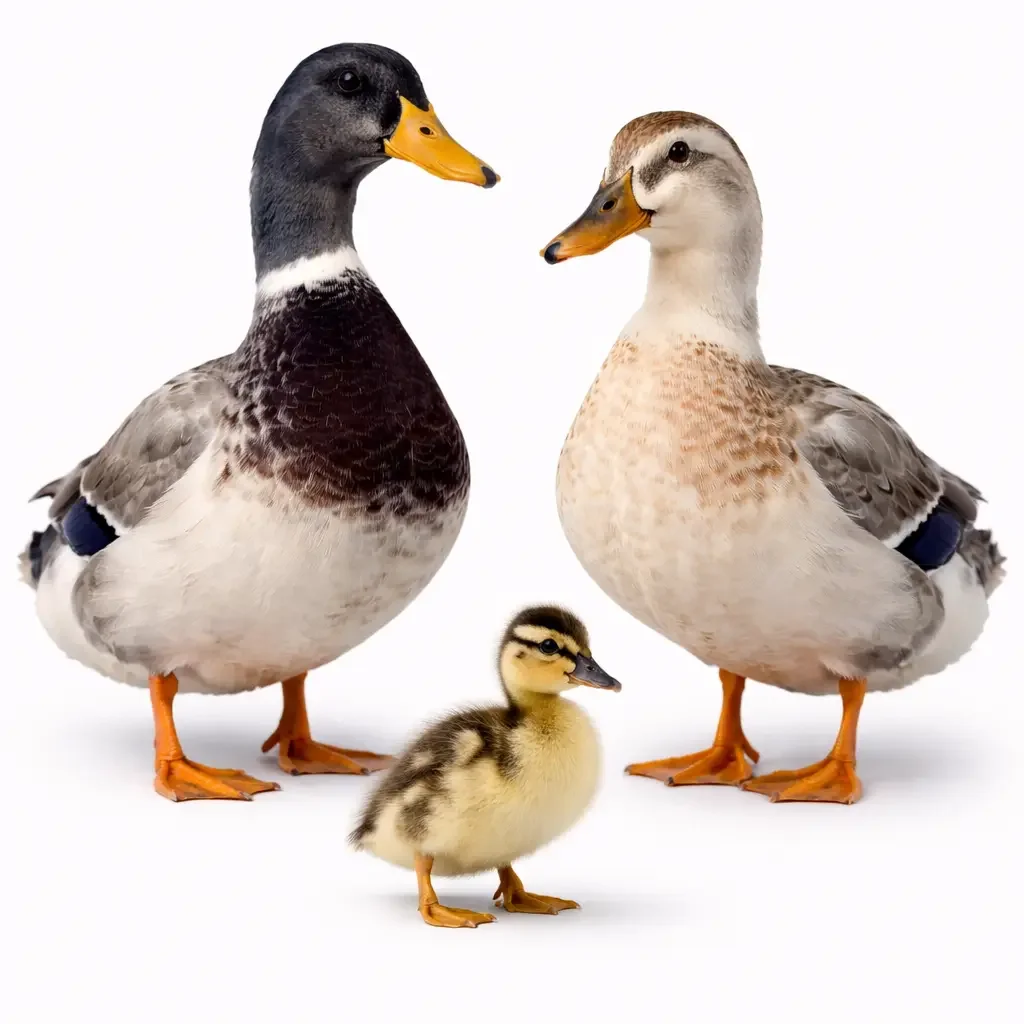
Feature image: Saxony drake showing blue-gray head, chestnut-burgundy breast, and cream underbodySecondary image: Saxony hen with buff and creamy white plumage foraging on pastureThird image: Pair of Saxony ducks on water
Breed Overview
The Saxony Duck was developed in Chemnitz, in the Saxony region of eastern Germany, by Albert Franz beginning in 1930. His goal was ambitious and specific: create a duck that excelled at exhibition, laid abundantly, and produced flavorful meat, all in a single breed. To achieve this, Franz crossed three established breeds: Rouen for body size and meat quality, German Pekin for growth rate and frame, and Blue Pomeranian for its distinctive blue-gray coloration and foraging ability. The result was first shown publicly at the Saxony Show of 1934, from which the breed took its name.
The early development was interrupted by the Second World War. Franz was imprisoned during the conflict and his original breeding stock was nearly entirely lost. After the war ended, he resumed his program using surviving birds and the parent breeds to rebuild the Saxony from the foundation up. Germany recognized it as a distinct breed in 1957. The breed was known in Germany as the Sachsen Ente and in France as the Le Canard de Saxe. It reached Britain during the 1970s and crossed the Atlantic in 1984 when Dave Holderread's Waterfowl Farm in Oregon imported birds and began establishing an American population. The American Poultry Association accepted the Saxony into its Standard of Perfection in the fall of 2000.
Despite this history and the breed's genuine merits, the Saxony remains Threatened in the United States according to The Livestock Conservancy, with fewer than 1,000 breeding birds and fewer than seven primary breeding flocks in the country. Global population is estimated below 5,000. This is a breed that requires dedicated breeder support to survive, and homesteaders who maintain quality Saxony flocks contribute directly to its conservation.
Plumage and Appearance
The Saxony's plumage is one of the most visually distinctive of any domestic duck, and it is primarily what separates the drake from every other breed in the yard at a glance.
The drake carries a blue-gray head, back, and wing markings unlike the green-black head of a Mallard-pattern drake. The breast is a rich chestnut-burgundy. The flanks and underbody are creamy white and the neck ring is white. The tail is dark with bronze tones. The bill is yellow or orange, often with pale green shading, and the legs and feet are orange or reddish-brown. The overall effect is a large, softly colored bird that reads as a pastel or watercolor version of a Mallard drake, with the same underlying pattern executed in a completely different palette.
The hen is buff overall with creamy white facial stripes, a white neck ring, and a cream-white underbody. Her bill is orange, often with brown shading, and her legs and feet are orange to reddish-orange. The buff tone across the back shows a fine penciling pattern that adds visual depth to what might otherwise appear as a plain bird. She lacks the eye stripes of Mallard-derived hens and presents as a clean, warm-toned bird that complements the drake's striking coloration.
The body is large and substantial: long and compact with broad shoulders, a prominent and smoothly rounded chest, a broad full abdomen without a keel, and strong legs set well apart. Carriage is held at ten to twenty-five degrees above horizontal when relaxed, giving the bird a forward-leaning posture associated with active foraging breeds. Drakes are approximately one pound heavier than hens on average.
Egg Production
Saxony egg production is genuinely impressive for a heavyweight breed and represents one of Albert Franz's key design goals in the original breeding program. Quality-bred hens produce 190 to 240 large white eggs per year, with some individual birds in well-managed heritage flocks reaching the upper end of that range consistently. This output competes favorably with lighter dual-purpose breeds and places the Saxony well above most other heavyweight ducks whose egg production is secondary to their meat utility.
An important distinction applies between quality breeding flock birds and general hatchery stock, as it does with most heritage breeds. Saxony hens from dedicated breeders who track and select for laying performance will consistently outperform birds from commercial hatcheries that have not maintained production-focused selection. The Threatened status of the breed means that the number of truly quality Saxony breeding operations in the United States is small, and sourcing from them requires research and often advance planning as waitlists for quality birds are common.
Eggs are large to extra-large and white-shelled, with occasional cream tinting depending on bloodline and individual hen. The shells are strong and the eggs perform well in all culinary applications. Saxony hens are noted as winter layers, continuing production through colder months more reliably than breeds that shut down in low light conditions, which is a practical advantage in the Midwest and northern homestead context.
The breed retains a moderate brooding instinct, more so than many production-focused lighter breeds. Hens from quality heritage lines will go broody and can successfully hatch and raise ducklings without incubator support, which appeals to homesteaders who want a more self-sufficient flock management approach.
Meat Quality
Saxony meat quality is the second half of the dual-purpose equation and delivers on it. Dave Holderread, the foremost American authority on domestic ducks, described Saxony meat as more flavorful and less fatty than faster-growing commercial breeds, a characterization consistently supported by homesteaders and chefs who have worked with the breed. The active foraging lifestyle produces lean, dark, and well-developed meat with a flavor profile that more closely resembles a wild duck than a heavy commercial breed.
The light undercoat feathering makes for a clean, appealing carcass presentation with minimal pin feather pigmentation in the dressed bird. Drakes reach a live weight of eight to nine pounds at maturity and provide a substantial carcass. Growth is slower than commercial Pekin or hybrid meat ducks, reaching processing weight in twelve to sixteen weeks rather than the six to eight weeks of a commercial meat operation, but the quality difference in the finished product is pronounced.
Best Preparations
The lean, flavorful Saxony breast is outstanding when pan-seared to medium with high heat and finished with butter and herbs, allowing the meat's natural flavor to carry the dish. Whole roasted Saxony at high heat produces a clean, well-browned carcass with excellent skin rendering. Duck confit works well with the thighs and legs, as the active lifestyle of a foraging breed produces well-developed muscle tissue that responds to slow cooking. Braised Saxony in wine or stock suits the slightly leaner carcass profile and produces deeply flavored results. The meat is robust enough to support bold preparations including duck sausage, terrines, and spiced slow-cooked dishes.
Temperament and Behavior
The Saxony's temperament is consistently described as one of its most appealing qualities and one of the primary reasons homesteaders seek it out beyond its production merits. The breed is docile and not easily startled, comfortable around children, tolerant of daily handling, and curious about its environment in a calm, exploratory way rather than the anxious, reactive way of lighter breeds like the Indian Runner or Khaki Campbell.
Both drakes and hens have friendly dispositions. Drakes are notably non-aggressive and quiet. Hens are more vocal, particularly when excited or during egg-laying, but their sound is described as a raspy, rough call rather than the sharp repetitive quacking of excitable breeds. The overall noise level of a Saxony flock is manageable in suburban and semi-rural settings, though hens will announce themselves when aroused.
The breed integrates well with other poultry and farm animals. Its calm character means it rarely bullies smaller breeds and is not easily intimidated by larger ones. Multi-species paddock management with Saxony ducks alongside chickens, geese, or other livestock is generally straightforward with adequate space and resources.
The recommended drake-to-hen ratio is one drake to four to six hens, consistent with most domestic duck breeds of similar size and libido. Maintaining appropriate ratios prevents overbreeding stress on hens and supports consistent fertility and flock welfare.
Foraging and Pasture Performance
The Saxony's foraging energy is one of the more pleasant surprises the breed delivers to homesteaders who expect heavy birds to be relatively sedentary. Despite its weight, the Saxony is an active and methodical forager that works pasture, garden edges, and wetland margins with genuine enthusiasm. The Blue Pomeranian genetics in its foundation are credited with contributing the foraging drive that distinguishes it from other large breeds, particularly the Pekin, which is comparatively passive in its feed-seeking behavior.
On quality pasture, Saxony ducks reduce feed costs by supplementing their diet with insects, worms, slugs, snails, aquatic invertebrates, and plant material. As pest control partners they are effective against the same targets as lighter foraging breeds while bringing a larger physical presence that allows them to work rougher terrain. Gardeners who use Saxony ducks for seasonal garden rotation report consistent performance on slugs and soil-dwelling insects without the aggressive excavation behavior that geese or aggressive chickens can cause.
The breed does not fly, eliminating the need for covered runs or wing clipping for confinement management. Standard perimeter fencing is sufficient.
Climate Adaptability
The Saxony is a hardy breed suited to a wide range of climates including the full spectrum of Midwest conditions. Its genetics from Rouen and Blue Pomeranian ancestors include cold-adapted lines, and the breed handles winter temperatures well when provided with wind-protected housing and access to water that does not freeze solid. The winter-laying tendency noted above reflects a breed that maintains metabolic activity through cold seasons rather than entering a productive shutdown.
In heat, the same water access and shade requirements that apply to all domestic ducks keep Saxony birds comfortable and productive. Their body mass means they are somewhat more susceptible to heat stress than lighter breeds if shade and cool water are not consistently available during peak summer temperatures, which is worth managing proactively in the warmer Midwest months.
Housing and Management
Saxony ducks require the same basic infrastructure as all domestic ducks with appropriate scaling for their larger body size. Floor space recommendations of five to six square feet per bird indoors and twelve or more square feet of outdoor run space reflect their heavier frame and the value of room to move without crowding stress. The breed's calm temperament means it tolerates confinement without the chronic anxiety responses seen in flightier breeds, but it performs best and produces most reliably with access to outdoor space.
Access to swimming water improves welfare, supports natural feather maintenance, and enhances foraging behavior. A rubber stock tank, plastic tub, or small pond serves the purpose for small flocks. The breed's active character means ducks will use swimming access regularly rather than ignoring it.
Pros and Cons
Pros
Outstanding dual-purpose performance: strong egg production and excellent meat quality in a single breed
One of the most visually distinctive and beautiful plumage patterns in domestic ducks
Docile, calm, and people-friendly temperament suitable for families with children
Retains brooding instinct more reliably than production-focused lightweight breeds
Active forager that contributes meaningfully to pest management and reduces feed costs
Winter-laying tendency provides year-round production continuity in cold climates
Does not fly; standard fencing is sufficient for confinement
Feathers and down are harvestable for pillow and bedding production
Keeping quality Saxony birds contributes directly to conservation of a threatened breed
Cons
Threatened conservation status means quality birds are difficult to source and require advance planning
Slower growth rate than commercial meat breeds; twelve to sixteen weeks to full market weight
Females can be noticeably vocal when excited or laying
Larger body size means higher feed consumption than lightweight breeds
Limited availability from dedicated breeding flocks in the United States
Less immediate egg production ceiling than Khaki Campbell or Welsh Harlequin in direct comparison
Profitability
The Saxony offers multiple revenue streams for homestead operations that invest in quality stock. Duck eggs from a Saxony flock sell at premium prices through farmers markets and direct-to-consumer channels, with the breed's large egg size supporting strong per-unit pricing. Whole dressed Saxony ducks sell well to customers seeking locally raised heritage poultry with a provenance story, and the breed's Threatened status adds a conservation narrative that resonates with informed buyers.
Hatching eggs and quality ducklings from well-documented Saxony bloodlines command significant premiums over commercial hatchery stock, given how few quality breeding operations exist in the United States. Homesteaders who establish and maintain a genuine quality Saxony breeding program can access a genuine seller's market for birds and hatching eggs. Down and feather harvest from a managed flock provides an additional income stream or homestead resource for pillow and bedding production.
Comparison With Related Breeds
Rouen Duck: One of the Saxony's foundation breeds, the Rouen is a large heavyweight dual-purpose duck with similar body size but slower growth and lower egg production. Rouen plumage follows the standard Mallard pattern with a green-black head rather than the Saxony's distinctive blue-gray. The Saxony represents an improvement over the Rouen in most productive measures while sharing its large, well-muscled frame. Homesteaders who want Mallard-pattern plumage in a large bird may prefer the Rouen for aesthetic reasons, though the Saxony outperforms it in most practical categories.
Pekin Duck: The Pekin is the dominant commercial meat duck and significantly outpaces the Saxony in growth rate and market weight achievement speed. For homesteaders whose primary goal is the fastest possible meat production, the Pekin is the correct choice. For those who want sustained egg production alongside quality meat from a breed with conservation value and superior flavor, the Saxony is clearly preferable. Pekin table fare is bland compared to the more robust Saxony meat.
Welsh Harlequin: A lightweight dual-purpose breed with superior egg production numbers in quality flocks and a calmer, quieter character than the Saxony hen. The Welsh Harlequin is the better choice for homesteaders whose primary metric is maximum egg count from a smaller, more feed-efficient bird. The Saxony delivers more meat per bird, more reliable broodiness, and a more dramatic visual presence in exchange for modest production trade-offs.
Silver Appleyard: Another heavyweight dual-purpose breed developed in Britain with a complex, beautifully marked plumage and strong dual-purpose credentials. Both the Appleyard and Saxony are heritage breeds on conservation watch lists with similar production profiles and exhibition value. The Appleyard is somewhat more established in the United States than the Saxony. The choice between them often comes down to plumage preference and sourcing availability in a given region.
Final Verdict
The Saxony Duck is a breed that deserves far wider recognition than its Threatened conservation status suggests it has received. It is large, beautiful, productive, calm, and carries a survival story that adds meaning to the practical decision to keep it. For Midwest homesteaders who want a heavyweight dual-purpose duck that genuinely earns its keep at the egg carton, the butcher block, and on the pasture, the Saxony is one of the most complete options in the domestic duck directory. The investment required to source quality birds is real, but the return across every dimension of homestead utility justifies it fully.
Frequently Asked Questions
How many eggs do Saxony ducks lay per year? Quality-bred hens produce 190 to 240 large white eggs per year. The breed is also noted as a winter layer, providing more consistent year-round production than breeds that reduce output significantly in low-light months.
Are Saxony ducks rare? Yes. They are classified as Threatened by The Livestock Conservancy with fewer than 1,000 breeding birds in the United States. Quality stock is difficult to source and typically requires purchasing from a short list of dedicated heritage breeders.
How big do Saxony ducks get? Drakes reach eight to nine pounds at maturity. Hens reach seven to eight pounds. This makes the Saxony one of the larger domestic duck breeds, comparable in frame to the Rouen.
Do Saxony ducks go broody? More reliably than most production-focused lightweight breeds. Heritage-line Saxony hens retain a meaningful brooding instinct and can successfully hatch and raise ducklings without incubator support, which is a practical advantage for homesteaders who want a more self-sustaining flock.
Is Saxony duck meat good? Yes. It is consistently described as more flavorful and less fatty than commercial Pekin, with a robust character that reflects the breed's active foraging lifestyle. It suits a wide range of preparations from simple pan-searing to confit and braising.
Where can I find Saxony ducks for sale? The Livestock Conservancy's breeders directory is the best starting point. Given the breed's Threatened status and the small number of quality breeding operations in the United States, planning ahead and joining waitlists is often necessary.