
Harlequin Duck
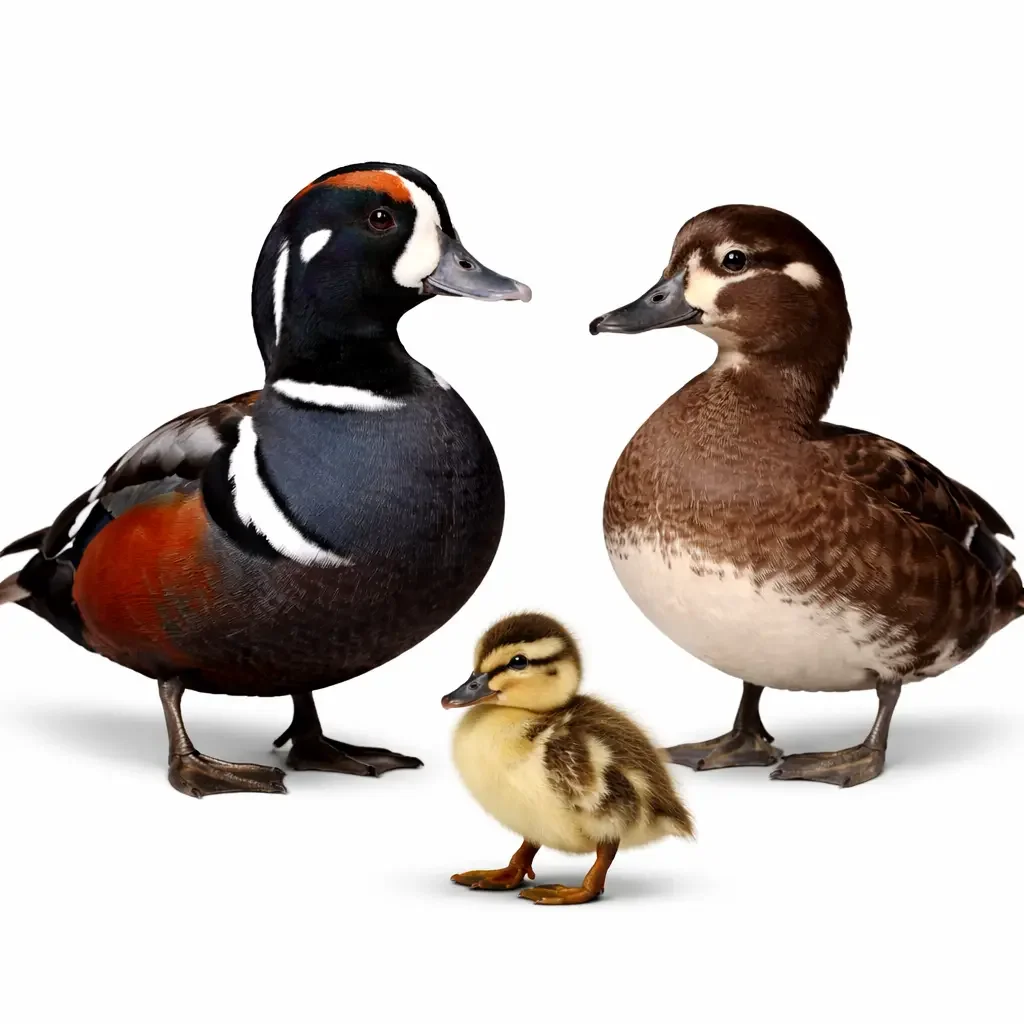
The Harlequin Duck is arguably the most visually spectacular sea duck in North America, a small and remarkably hardy bird that makes its living in some of the most violent water on the continent. It breeds along whitewater mountain streams in the Rocky Mountains, Pacific Northwest, and boreal Canada, and winters on wave-battered rocky coastlines where few other waterfowl species venture. For Midwest hunters and homesteaders, the Harlequin Duck has essentially no direct relevance to day-to-day waterfowl management or hunting, but it belongs on any complete list of North American waterfowl and its extraordinary natural history rewards any serious student of the continent's duck fauna.
Quick Facts
Breed Type: Wild Duck (Sea Duck)
Purpose: Reference Knowledge, Wildlife Observation, Limited Subsistence Hunting in Alaska
Origin: North America, Iceland, Greenland, and eastern Siberia
Egg Production: Not applicable (wild species)
Egg Color: Pale buff to cream, laid in rocky crevices, cliff ledges, tree cavities, or ground nests near fast-moving streams
Adult Weight: Drake 1.0 to 1.5 lbs, Hen slightly lighter
Temperament: Social and active, tolerates rough water conditions no other duck species can exploit
Hardiness: Exceptionally cold and wave hardy, among the toughest small waterfowl in the world
Broodiness: Moderate, hens incubate and raise young independently after males depart
Lifespan: Up to 20 years in the wild based on banding records, though the rough lifestyle takes a toll
Image Section
Main Image: Harlequin Duck drake in full breeding plumage on rocky whitewater, slate blue body with white and chestnut markings visible, 1024x1024, white or transparent background.
Breed Overview
The Harlequin Duck, known scientifically as Histrionicus histrionicus, is the smallest of the sea ducks and the most uniquely adapted to fast-moving, turbulent water. Its common name derives from the colorful harlequin character of Italian Commedia dell'arte, and its scientific name comes from the Latin histrio meaning actor, both references to the theatrical complexity of the drake's plumage. It has also been called painted duck, rock duck, glacier duck, squeaker, and lords and ladies across its range.
The drake in breeding plumage is one of the most complex-patterned birds in North America. His body is a rich slate blue-gray bordered by bold black lines and accented with a large white crescent in front of the eye, a small white dot behind the eye, a white vertical stripe on the side of the neck, white markings on the back and wings, and rich chestnut flanks. The hen is a subdued grayish-brown with a white belly, a white triangular patch in front of the eye, and a small white spot behind the eye. Both sexes appear grayish-blue in flight with no white wing patches, which helps distinguish them from Buffleheads and scoters in the field.
The species breeds in two geographically separated populations in North America. The larger Western Population breeds in mountain streams of the Pacific Northwest, Rocky Mountains, western Canada, and Alaska, wintering on the Pacific Coast from Alaska south to northern California. The smaller and more vulnerable Eastern Population breeds in the maritime provinces of eastern Canada and winters on the Atlantic Coast from Newfoundland south to Chesapeake Bay. The eastern population is considered endangered in Canada due to significant historical decline.
One of the most striking biological facts about the Harlequin Duck is the physical toll its chosen lifestyle extracts. Studies using X-rays and museum specimens have established that most adult Harlequins live with multiple healed bone fractures, broken and re-healed from a lifetime of being tumbled through whitewater rapids and pounded by ocean surf on rocky coastlines. No other bird species in North America has been documented to endure routine skeletal trauma as a normal aspect of daily life at this scale. The birds' densely packed, air-trapping feathers that provide insulation also give them exceptional buoyancy that contributes to their bounce-back-like-a-cork resilience after being submerged by waves.
Midwest Relevance
The Harlequin Duck has essentially no direct relevance to Midwest homesteaders or hunters. It does not breed, migrate through, or winter in the Midwest under any normal circumstances. Its range is coastal and mountain, not prairie and inland lake. The Rocky Mountain breeding population's closest approach to the Midwest is the Greater Yellowstone Ecosystem in Wyoming, which is on the western edge of the broader region.
For Midwest waterfowlers, the Harlequin Duck is pure reference knowledge, part of completing a thorough foundation of North American waterfowl understanding. It appears on waterfowl regulations as a prohibited or closed species in most flyway states east of the Rockies, and knowing why hunting it is prohibited in most of its eastern range is part of understanding the regulatory framework that governs all duck hunting on the continent.
Hunting the Harlequin Duck
Where and Who Can Hunt It
Hunting seasons for Harlequin Duck are extremely limited and geographically restricted. In the eastern United States and eastern Canada, hunting Harlequin Ducks is closed entirely due to the endangered status of the eastern population. Most Atlantic Flyway and Mississippi Flyway states explicitly prohibit harvest, and this prohibition is listed in duck hunting regulations.
In Alaska and parts of western Canada, subsistence hunting by native communities is permitted and has continued traditionally. Commercial and recreational hunting opportunities are minimal and tightly managed given the species' small population size and the ongoing effects of the 1989 Exxon Valdez oil spill, which was still affecting Alaskan Harlequin Duck survival rates as late as 1998. Average annual harvest across the United States from 1999 to 2008 was approximately 1,258 birds, with over 90 percent occurring in Alaska.
In Washington State, hunters pursuing sea ducks in western Washington are required to record and report all harvest effort and activities including Harlequin Duck encounters, as part of ongoing population monitoring.
Identification in the Field
The drake Harlequin Duck is unmistakable in breeding plumage. No other North American duck combines the slate blue body, bold white facial markings, chestnut flanks, and complex white striping pattern of the male Harlequin. The hen's combination of brownish-gray plumage, white facial patches, and lack of wing markings distinguishes her from scoters by smaller size and steeper forehead, and from Buffleheads by the brown breast and more complex facial pattern.
Both sexes have all-dark wings in flight with no wing patches, a field mark that helps hunters positively identify the species before shooting in mixed-species sea duck situations. The species' call is an unduck-like squeak, earning it the nickname sea mouse in some coastal communities, and flocks make a distinctive squeaking chorus audible at distance.
Meat Quality
Harlequin Duck is considered poor table fare, consistent with other sea ducks whose diets consist almost entirely of marine invertebrates including mussels, limpets, periwinkles, crabs, barnacles, and amphipods. The accumulated flavors from a lifetime of shellfish consumption produce strong, fishy-flavored meat that most hunters who have tried it describe as unpalatable without significant preparation. The species is small, producing minimal breast meat per bird even when harvested. Most hunters who encounter Harlequin Ducks in Alaska or coastal settings treat them as a trophy and observation species rather than a table bird.
Behavior and Identification
The Harlequin Duck is one of the most physically capable waterfowl in the world for its size. It navigates fast-moving whitewater rapids with ease, using its powerful feet to maintain position against strong currents and climbing easily on steep, slippery rocks. Underwater it propels itself by feet with wings slightly spread for steering, and can dive to depths of up to 70 feet with dives lasting up to 45 seconds. It pries invertebrates from submerged rocks using its bill, a foraging technique adapted to the rocky substrates of both its breeding streams and its coastal wintering habitat.
Pair bonds are long-term, maintained from year to year between the same individuals, a relatively unusual trait among ducks where most species form new pairs annually. Males participate in elaborate head-nodding and rushing displays throughout winter to maintain and reinforce pair bonds with their established partners. Despite the long-term bond, males abandon females once incubation begins, departing for coastal molting areas while hens raise young independently.
Climate and Range
The Western Population breeds from Alaska south through the Rocky Mountains to Wyoming and the Pacific Northwest, with the Yellowstone and Grand Teton areas representing the southernmost significant breeding concentration in the interior. These birds winter on the Pacific Coast from Alaska to northern California. The Eastern Population breeds in Quebec, Labrador, and the maritime provinces of Canada and winters on the Atlantic Coast from Newfoundland south to Chesapeake Bay.
The species is sensitive to water quality and stream integrity on its breeding grounds. Logging that removes forest canopy from stream corridors, siltation from land disturbance, and hydroelectric development that alters natural stream flow all threaten breeding habitat quality. Oil spills on coastal wintering grounds have caused documented population impacts, with the Exxon Valdez spill providing the most thoroughly studied example of oil's long-term effects on sea duck survival and reproductive success.
Conservation Status
The global Harlequin Duck population is estimated at approximately 170,000 individuals and is rated of moderate conservation concern. The eastern North American population is considered endangered in Canada, with historically smaller numbers and a more restricted range making it more vulnerable to disturbance and habitat degradation than the western population. Hunting seasons in eastern North America are fully closed in recognition of this vulnerability.
The western population is more numerous and considered stable or increasing in some areas, but faces ongoing threats from coastal development, oil spill risk, and climate-driven changes to mountain stream hydrology that affect breeding habitat quality and the timing of invertebrate prey availability.
Homestead Suitability and Pond Management
The Harlequin Duck has no relevance to homestead pond management anywhere in the Midwest or Great Plains. It is a coastal and mountain specialist that requires fast-moving rocky streams for breeding and wave-swept rocky marine shorelines for wintering. No habitat modification on a Midwest homestead will attract or support this species under any circumstances.
Its value in this guide series is purely as reference knowledge that rounds out a complete picture of North American waterfowl diversity and the regulatory context within which duck hunting operates across the continent.
Pros and Cons
Pros
The Harlequin Duck is one of the most visually stunning waterfowl species in the world, with a drake plumage that rewards careful observation in dramatic natural settings. Its extraordinary adaptation to rough water environments makes it one of the most fascinating examples of ecological specialization in North American birds. For birders and wildlife photographers visiting the Rocky Mountains or Pacific Coast, it is a genuinely memorable and rewarding species to encounter. Its conservation story, particularly the long-term effects of the Exxon Valdez oil spill and the endangered status of the eastern population, is an important chapter in North American wildlife management history.
Cons
It has no direct relevance to Midwest hunting or homestead management. Hunting is closed in most of its eastern range and tightly limited in its western range due to small population size. Meat quality is poor. The species requires habitat conditions entirely unlike anything available in the Midwest. Knowledge of this species for the Midwest audience is purely reference-level rather than practical.
Profitability Note
As a wild and federally protected species whose hunting is closed across most of its range, the Harlequin Duck has no commercial or economic relevance to Midwest homesteaders. Its value is entirely in completing a thorough understanding of North American waterfowl. The profitability section applies fully when this guide series covers domestic duck breeds.
Comparison With Related Species
Harlequin Duck vs Long-tailed Duck
Both are small sea ducks that winter on challenging open and coastal water, but the Long-tailed Duck has significant Midwest relevance through its Great Lakes wintering population while the Harlequin Duck does not. The Long-tailed Duck's complex seasonal plumage and the Harlequin's complex permanent plumage both make them standout identification subjects in the sea duck world.
Harlequin Duck vs Bufflehead
The Bufflehead is a similarly small diving duck that is sometimes confused with female Harlequin Ducks. The Bufflehead has a rounder head, shorter bill, white flanks on males, and a large white wing patch visible in flight that the Harlequin lacks. Buffleheads winter much more commonly on Midwest inland waters while Harlequins are almost exclusively coastal and mountain.
Harlequin Duck vs Common Goldeneye
The Common Goldeneye is a larger diving duck that winters on the Great Lakes and large Midwest inland lakes, giving it far more relevance to the Midwest audience than the Harlequin. Both are striking ducks with bold facial markings on the drake, but the Goldeneye is found in entirely different habitats from the Harlequin.
Final Verdict
The Harlequin Duck earns its place in this guide series as one of the most extraordinary and biologically remarkable waterfowl in North America, even though it will never appear on a Midwest homestead pond or in a Midwest hunter's bag. Its combination of spectacular plumage, extraordinary physical adaptation to violent water, long-term pair bonds, and conservation vulnerability makes it one of the most compelling species in the entire North American waterfowl fauna. Every serious waterfowler and homestead wildlife enthusiast who builds a complete knowledge base of North American ducks should know this bird well, even if only to fully appreciate how diverse and remarkable the duck family is across this continent.
Frequently Asked Questions
Can I hunt Harlequin Ducks in the Midwest?
No. Harlequin Duck harvest is closed across all Atlantic and Mississippi Flyway states. The species does not occur in the Midwest under normal circumstances and is explicitly listed as a closed species in duck hunting regulations across most of its eastern range.
Why is Harlequin Duck hunting closed in the eastern United States?
The eastern North American population of Harlequin Ducks is considered endangered in Canada and has declined significantly from historical numbers. Hunting is closed in eastern states and provinces to protect the small remaining population from additional harvest pressure while conservation efforts focus on understanding and addressing the causes of the decline.
Where can Harlequin Ducks be legally hunted?
Limited subsistence hunting by native communities in Alaska and parts of western Canada represents the primary legal harvest opportunity. Recreational hunting seasons are minimal across the species' western range and are managed carefully given the small total population size. Hunting is closed across all eastern North America.
What makes the Harlequin Duck unique among North American waterfowl?
Several features set it apart. Its adaptation to whitewater rapids for breeding is unique among North American ducks. Its long-term pair bonds maintained between the same individuals from year to year are unusual in a group where most species form new pairs annually. The documented prevalence of healed bone fractures from its rough lifestyle is found in no other bird species at comparable rates. And its plumage complexity, with multiple precise white markings on a slate blue body, is unmatched among North American sea ducks.
Does the Harlequin Duck ever appear in the Midwest?
Extremely rarely, as an accidental vagrant far outside its normal range. Any sighting of a Harlequin Duck in a Midwest inland location would be noteworthy and unusual enough to warrant documentation and reporting to state wildlife authorities or ornithological records committees.