
Common Merganser
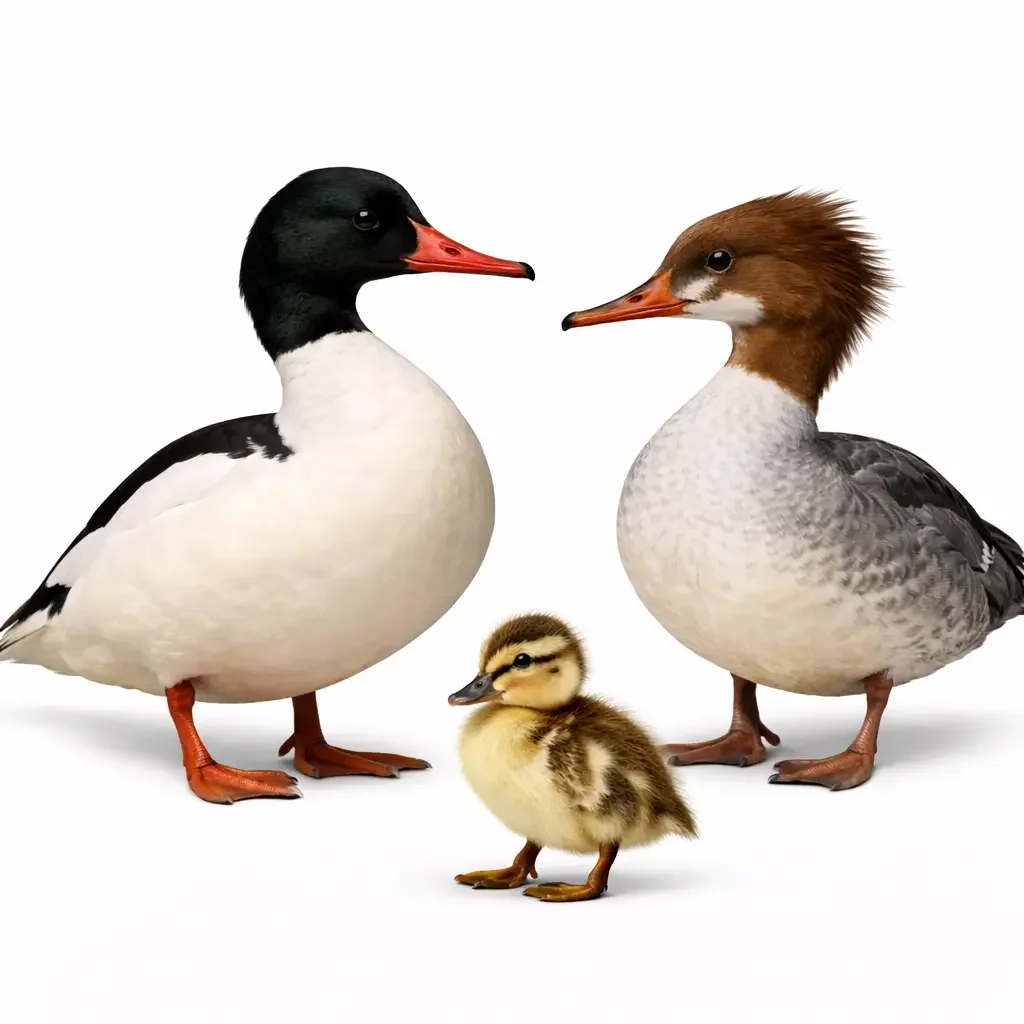
The Common Merganser is the largest duck that regularly uses Midwest rivers and lakes, a striking and ecologically important cavity-nesting fish predator that serves as one of the best indicators of freshwater ecosystem health in the region. Known to hunters and anglers by its common nicknames of sawbill, fish duck, and goosander, it is a bird that inspires strong and divided opinions. Fishermen sometimes view it as competition, hunters generally pass on it for the table, and wildlife observers find its bold plumage and fluid river behavior genuinely beautiful. For Midwest homesteaders, understanding the Common Merganser means understanding one of the most capable aquatic predators in the freshwater landscape.
Quick Facts
Breed Type: Wild Duck (Merganser)
Purpose: Reference Knowledge, Wildlife Observation, Nest Box Attraction, Limited Hunting
Origin: Circumpolar, breeds across boreal North America, Europe, and Asia
Egg Production: Not applicable (wild species)
Egg Color: White to yellowish, laid in large tree cavities or nest boxes near rivers and lakes
Adult Weight: Drake 2.5 to 4.4 lbs, Hen 1.9 to 3.5 lbs
Temperament: Alert and wary on the water, strong flier, forms flocks on large water bodies in winter
Hardiness: Partial migrant, cold hardy wherever open water remains
Broodiness: Moderate, hens incubate and raise young independently, famous for forming large creches of combined broods
Lifespan: Up to 13 years in the wild based on banding records
Image Section
Main Image: Common Merganser drake in full breeding plumage on clear river water, iridescent green head and white body with salmon-pink tinge visible, red serrated bill prominent, 1024x1024, white or transparent background.
Breed Overview
The Common Merganser, known scientifically as Mergus merganser and called the Goosander in Europe, is the largest of the three merganser species in North America and one of the largest freshwater ducks on the continent. It occupies a unique ecological role as a top-level aquatic predator in boreal and temperate river and lake systems, hunting fish primarily by sight in clear, cold water.
The drake in breeding plumage is a genuinely impressive bird. His iridescent dark green head, which lacks the visible crest present on Red-breasted and Hooded Mergansers, is sharply defined against his clean white neck and body with a variable salmon-pink tinge to the breast. His scarlet-orange serrated bill and red-orange feet complete a bold and distinctive appearance. The hen is equally elegant in her own way, with a rich rusty-brown head sharply defined against her clean gray body and white throat, the same scarlet-orange bill, and a modest crest that can be raised slightly. Both sexes show large white wing patches clearly visible in flight.
The serrated bill, which gives the sawbill nickname its origin, is lined with backward-pointing tooth-like projections called serrations that function as a fish trap, allowing the merganser to grip slippery prey securely once caught. This specialized bill reflects the species' complete commitment to fish as the primary food source, unlike other dabbling or diving ducks that supplement aquatic plants with invertebrates and seeds.
Common Mergansers are cavity nesters that require large hollow trees near water for successful breeding. They readily use large nest boxes where provided, and homesteaders with mature wooded creek or river corridors on their properties can attract nesting pairs by installing appropriately sized boxes. Like the Hooded Merganser and Wood Duck, the Common Merganser's use of nest boxes makes it a species that responds directly to homestead management.
One of the most remarkable behavioral traits of Common Merganser hens is the formation of creches, groups of combined broods attended by one or a few adult females while other hens are absent. Single females have been documented with over 70 ducklings at one time, creating remarkable flotillas of small gray-striped chicks trailing behind a single hen on clear boreal rivers and lakes.
Midwest Relevance
The Common Merganser has meaningful relevance to Midwest homesteaders and hunters as a regular winter visitor and locally a breeding bird on clear rivers and wooded lakes in the northern Midwest. In Minnesota, breeding populations have expanded southward over recent decades, with nesting confirmed in additional counties through improved water quality and available nest cavity sites. In Wisconsin and Michigan, it is a common winter bird on large rivers and the Great Lakes.
During fall and winter, Common Mergansers appear on most large Midwest rivers and lakes as migrants and wintering birds, often in impressive numbers on productive fish-bearing water bodies. Hunters working river corridors and large lake shores encounter them as part of the late-season mixed diving duck picture.
Hunting the Common Merganser
Season and Bag Limits
Common Mergansers are included in the merganser aggregate bag limit in most Midwest states, which typically allows five mergansers per day with no more than two Hooded Mergansers within that total. Common and Red-breasted Mergansers count freely toward the remaining three-bird allowance within the aggregate. The relatively liberal merganser limits reflect the species' healthy population and lower conservation concern status compared to most other waterfowl.
In some historical periods, merganser limits were exceptionally generous due to perceived competition with sport fisheries. A 1944 US Fish and Wildlife Service directive specifically cited merganser impact on fish hatcheries as justification for a bag limit of 25 birds per day, a limit that would be unthinkable by modern standards and that reflected attitudes toward fish-eating birds that have since changed significantly.
Where to Hunt
Common Mergansers are birds of clear, fish-bearing rivers and large lakes. In the Midwest, look for them on major rivers including the Mississippi, Missouri, Wisconsin, and their tributaries during fall and winter migration, and on large lakes and reservoirs wherever good fish populations and sufficient water clarity exist. They tend to use slightly deeper water than Hooded Mergansers and are more commonly found on main river channels and large open lake areas rather than small ponds and beaver flowages.
They regularly form large flocks on productive wintering water, and large river stretches with concentrations of forage fish in late fall and winter can hold impressive numbers of Common Mergansers alongside Common Goldeneye, Buffleheads, and other diving species.
Difficulty of Hunting and Table Quality
The honest reason most experienced hunters pass on Common Mergansers is table quality, which is consistently described as the poorest of any waterfowl species commonly encountered in the Midwest. The Missouri Department of Conservation's field guide description of the meat as a flavor "not much superior to that of an old kerosene lamp-wick" reflects a sentiment found in hunter accounts across the continent. The species' exclusively fish-based diet produces meat with an intensely fishy, oily flavor that most hunters describe as beyond redemption regardless of preparation method.
Most Midwest hunters treat Common Mergansers as a pass bird, watching them with appreciation as impressive river birds but rarely raising a shotgun. The conservation-minded approach of most modern hunters, combined with the species' ecological role as a water quality indicator, further discourages casual harvest.
Meat Quality
Common Merganser is universally considered the poorest-tasting duck in North America. The diet of fish, fish, and more fish produces dark, oily, intensely fishy meat that has defeated even the most determined kitchen efforts. Unlike the Hooded Merganser where aggressive marinating and slow cooking can produce acceptable results with some birds, Common Merganser meat is rarely improved to a genuinely palatable state by any preparation method available to the home cook.
Some hunters who do harvest Common Mergansers in areas where they are feeding on clean cold-water fish species rather than warm-water rough fish report slightly better results, but the consensus across experienced waterfowlers is that this is a species to observe rather than harvest for food.
Behavior and Identification
The Common Merganser is one of the most elegant-looking birds on Midwest waterways in flight. The clean white underparts with green head on the drake, or rusty head with gray body on the hen, combined with the long slender profile and large white wing patches, produce a distinctive silhouette identifiable at considerable distance. In flight they hold the bill, head, neck, body, and tail in a perfectly horizontal line, an alignment more pronounced than in most other ducks that typically show some downward curve to the head. The wings produce a distinctive whirring sound audible at moderate distances, earning the species another colloquial name of the whistler in some regions.
On the water, Common Mergansers float low and streamlined, often with the bill and forehead at or just above water level as they scan for fish below. They dive smoothly and powerfully, propelling themselves with their feet to chase fish through clear water. Their eyes are specially adapted for underwater vision, allowing them to track fast-moving fish in the aquatic environment where their serrated bill does the capturing work once contact is made.
The Common Merganser can be distinguished from the Red-breasted Merganser by the male's clean white breast and sides versus the reddish-brown breast and gray sides of the Red-breasted, and by the clean line between the rusty head and white body on the female Common versus the less sharply defined transition on the female Red-breasted. Common Mergansers also lack the ragged crest visible on both sexes of the Red-breasted Merganser.
Climate and Range
The Common Merganser breeds across the boreal forest zone of North America from Alaska through Canada, south along the Rocky Mountains to approximately Colorado, and in the northeast south to Pennsylvania. It requires mature forest with large cavity trees adjacent to clear, productive fish-bearing rivers and lakes. The species is a partial migrant, with populations in the northern portions of the range migrating south to open water while birds in southern breeding areas may remain year-round wherever ice does not close the water.
In the Midwest, Common Mergansers are present from late October through March or April on major rivers and large lakes. They arrive as northern birds push south ahead of freeze-up and depart in early spring as breeding waters open in Canada. In Minnesota and Wisconsin, small breeding populations use clear river systems in the northern portions of those states.
Homestead Suitability and Pond Management
The Common Merganser is not relevant to small homestead pond management in most of the Midwest. It requires large, clear, fish-bearing water bodies and mature forested corridors for both breeding and foraging. Small farm ponds, shallow marsh areas, and most homestead water features will not attract this species under any normal circumstances.
For homesteaders located along clear, well-wooded river corridors in the northern Midwest, the Common Merganser is a potential nest box species. The nest box specifications differ substantially from Wood Duck and Hooded Merganser boxes, requiring a much larger entrance hole of approximately six inches in diameter to accommodate the larger body size. Installing large nest boxes near clear-water rivers in mature wooded settings can attract breeding pairs and support the species' range expansion southward that has been documented in recent decades as water quality has improved.
Value as a Water Quality Indicator
The Common Merganser's requirement for clear, clean, fish-bearing water makes it one of the best biological indicators of freshwater ecosystem health. A river or lake that supports breeding Common Mergansers is demonstrably clean enough to support healthy fish populations, adequate water clarity for visual predation, and mature riparian forest with cavity trees. Property owners who see Common Mergansers using their water year-round can take it as a meaningful signal of good water quality and ecosystem function.
Pros and Cons
Pros
The Common Merganser is one of the most visually impressive ducks on Midwest waterways, with a drake plumage that rewards careful observation on any winter river. It serves as an excellent biological indicator of clean, healthy freshwater ecosystems. Its use of large nest boxes gives homesteaders with forested river frontage a direct role in supporting the species. It is large enough to be a memorable encounter for birders and wildlife observers on any clear Midwest river. Its ecological role in regulating fish populations has positive effects on sport fisheries despite traditional perceptions to the contrary.
Cons
Meat quality is the worst of any common Midwest waterfowl, essentially inedible to most hunters regardless of preparation method. This effectively removes it from consideration as a table bird for most hunters. Its requirement for clear, fish-bearing rivers and large lakes limits its relevance to homesteaders without access to those specific habitats. The historical conflict with fishing interests, while largely based on exaggerated claims, creates occasional negative perceptions among anglers.
Profitability Note
As a wild and federally protected migratory species, Common Mergansers cannot be commercially sold. Their value to homesteaders is primarily ecological and observational rather than economic. Properties along clear northern Midwest rivers where Common Mergansers breed or winter have enhanced wildlife value that contributes to overall property attractiveness for conservation and recreational purposes. The profitability section applies fully when this guide series covers domestic duck breeds.
Comparison With Related Species
Common Merganser vs Hooded Merganser
The Hooded Merganser is the smallest and most commonly encountered merganser in wooded Midwest wetlands. It shares the cavity-nesting habit and uses the same nest boxes with slight size adjustments, but prefers smaller, more sheltered wooded ponds and creeks over the large open rivers and lakes favored by the Common Merganser. The Hooded Merganser has a more diverse diet that includes crayfish and aquatic invertebrates alongside fish, giving it modestly better table quality. The drake Hooded Merganser's fan crest is unmistakable compared to the smooth rounded head of the male Common Merganser.
Common Merganser vs Red-breasted Merganser
The Red-breasted Merganser is the intermediate-sized species between Hooded and Common Mergansers. It is more strongly coastal and Great Lakes-associated than the Common Merganser in winter, preferring saltwater and brackish environments where the Common prefers freshwater. The Red-breasted Merganser drake's ragged crest, reddish-brown chest, and mottled gray sides distinguish him from the clean-breasted Common Merganser drake. Both species are considered poor table fare.
Common Merganser vs Common Goldeneye
The Common Goldeneye frequently shares large river and lake habitat with wintering Common Mergansers and is often found in mixed flocks with them. The Goldeneye is considerably smaller, has a distinctive round white facial spot on the drake, and is considered significantly better table fare. Both species use cavity nest sites and can be attracted with appropriately sized nest boxes.
Final Verdict
The Common Merganser is a bird that earns respect for its ecological importance, its visual impact on Midwest waterways, and its role as a biological indicator of clean freshwater ecosystems, even though it occupies the bottom tier for table quality among all Midwest waterfowl. For homesteaders along northern Midwest rivers, it is worth knowing well as a potential nest box tenant and as a reliable indicator of water quality. For hunters, it is a pass bird that adds variety and visual interest to winter river hunting without contributing meaningfully to the table.
Any Midwest hunter or homesteader who takes the time to watch Common Mergansers fishing a clear winter river in early morning light will understand why this bird belongs in a complete catalog of North American waterfowl, regardless of what it tastes like.
Frequently Asked Questions
Are Common Mergansers good to eat?
No, Common Merganser is universally considered the worst-tasting duck in North America. The exclusively fish-based diet produces intensely fishy, oily meat that most hunters describe as beyond redemption regardless of preparation method. Most experienced waterfowlers pass on this species entirely.
Can I attract Common Mergansers to my property with nest boxes?
Yes, if your property includes mature forested corridors along clear, fish-bearing rivers or larger lakes in the northern Midwest. The nest box requires a larger entrance hole of approximately six inches in diameter compared to Wood Duck boxes. Placement near clear water with good fish populations in areas with mature trees is essential. The species does not use small farm ponds or shallow wetlands.
How do I identify a Common Merganser versus a Red-breasted Merganser?
The male Common Merganser has a clean white breast and sides and no visible crest, while the male Red-breasted has a reddish-brown chest, gray sides, and a ragged crest. The female Common has a very sharply defined white chin patch and a clean separation between her rusty head and gray body, while the female Red-breasted has a less distinct head-body transition and lacks the bold white chin patch. In winter, Common Mergansers are far more commonly found on freshwater while Red-breasted prefer coastal and brackish habitats.
How many Common Mergansers can I shoot per day?
Common Mergansers count toward the general merganser aggregate limit of five birds per day in most states, with no specific Common Merganser sub-limit beyond the general merganser total. The only species-specific restriction within the merganser aggregate in most states is the two-Hooded Merganser limit.
What does it mean for water quality if Common Mergansers are on my river?
It is a positive indicator. Common Mergansers require clear water for visual predation, clean water that supports healthy fish populations, and mature riparian forest with cavity trees for nesting. Their presence as breeders or regular winter visitors signals water quality and ecosystem health that exceeds the requirements of most other waterfowl species.