
The Zucchini Section Is Done!
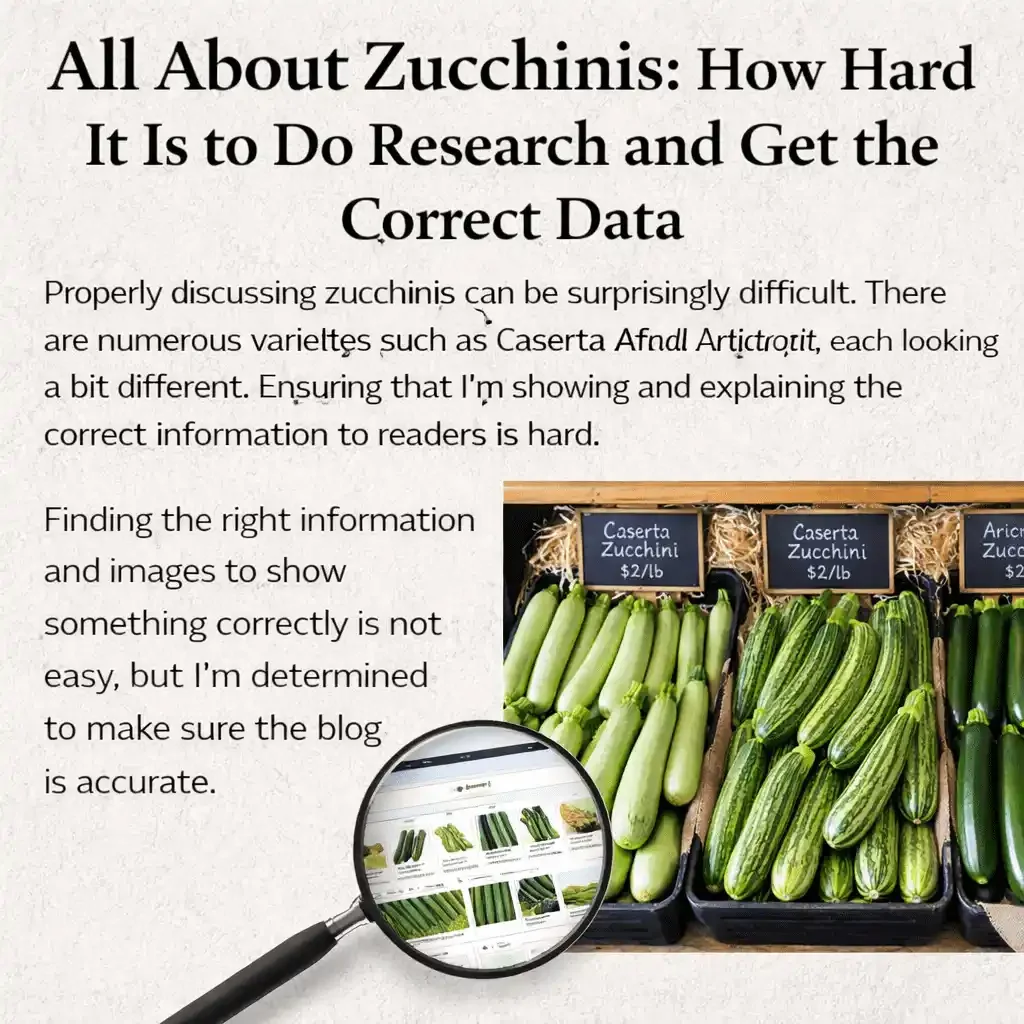
15 Varieties, Hundreds of Hours, and One Very Satisfying Finish Line
A Behind-the-Scenes Look at Building Our Vegetable Varieties Library
A Week Well Spent
After a full week of deep research, writing, image creation, and more editing than I care to admit, I am thrilled to announce that the Zucchini section of our Vegetable Varieties library is officially complete. Fifteen individual variety guides, each one a comprehensive seed-to-table resource, now live under the Zucchini category. It has been one of the most rewarding and most challenging sections I have tackled so far, and I wanted to take a moment to pull back the curtain and share what went into making it happen.
Every variety got the same treatment: detailed growing instructions, planting timelines, companion planting advice, storage tips, recipe ideas, and carefully crafted images to match. But every variety also came with its own unique set of challenges. Some were research puzzles. Some were visual headaches. Some surprised me entirely. Below is a quick look at each of the 15 varieties and the specific challenge that made it memorable.
15 Varieties, 15 Challenges
Aristocrat - Aristocrat is an F1 hybrid, which meant I could not find the kind of deep heritage story that heirloom varieties offer. Tracking down its 1973 AAS award documentation and confirming that it is now sold under the trade name Commander by some seed companies took real digging. Creating an image that captured its distinctive waxy, glossy sheen without making the fruit look artificially shiny was another balancing act entirely.
Black Beauty - You would think the most popular zucchini in America would be the easiest to write about, but the opposite was true. There is so much generic information floating around that separating the variety-specific facts from the recycled filler was exhausting. Pinning down its exact parentage as a stabilized cross between Salerno and Caserta at the Connecticut Agricultural Experiment Station required cross-referencing multiple historical sources. The image challenge was getting that deep, almost-black green skin to read as green and not just dark in photos.
Caserta - Caserta's beautiful pale green skin with dark green parallel stripes made for a gorgeous image, but getting the stripe pattern to look natural and not like a painted watermelon was tricky. On the research side, untangling its Italian cocozelle heritage and its role as the parent variety for Black Beauty added a fascinating layer of history that I had not expected to find.
Cocozelle - This is one of the original Italian zucchini varieties brought to America by immigrants in the early 1900s, and finding reliable English-language documentation on its specific origins was a real challenge. Much of the best information existed only in Italian gardening sources and historical seed catalogs. The long, slender shape with alternating dark and light green stripes also made for a complex image to get right, especially showing the subtle color variation between young and mature fruit.
Costata Romanesco - Costata Romanesco tested my patience more than any other variety. Its deeply ribbed, star-shaped cross-section is what makes it so visually striking, but capturing that texture in an image without it looking lumpy or deformed required multiple attempts. On the research side, sorting through conflicting claims about its flavor profile and documenting why many chefs consider it the best-tasting zucchini in the world meant reading through countless culinary sources to separate opinion from well-supported consensus.
Dunja - Dunja is a modern hybrid with impressive disease resistance, particularly to powdery mildew, watermelon mosaic virus, and zucchini yellow mosaic virus. The challenge was making a disease-resistant hybrid sound exciting to home gardeners who might otherwise dismiss it as a commercial variety. Highlighting its organic farming credentials and its AAS award helped, but the real work was in the writing: making technical disease resistance data feel relevant and compelling to a backyard grower.
Eight Ball - Everything about Eight Ball broke the mold. It is round, not cylindrical, which meant rethinking my entire image composition approach. Writing about spacing, harvesting, and storage for a spherical zucchini required adjusting the advice I had developed for the standard elongated shape. Even the recipe section needed a different angle, since Eight Ball's shape makes it a natural candidate for stuffing in ways that do not work with traditional zucchini.
Fordhook - Fordhook is a classic mid-century variety with a strong historical connection to the Burpee seed company, but detailed variety-specific growing data proved surprisingly scarce. Much of the available information was generic summer squash advice with Fordhook's name attached. Digging up its actual release history, growth characteristics, and what distinguishes it from other medium-green bush zucchini required going beyond the typical seed catalog descriptions.
Gold Rush - Gold Rush's vivid golden-yellow skin was both a gift and a challenge for image creation. The color photographs beautifully, but getting the shade accurate, a true warm gold rather than a washed-out yellow or an unrealistic neon, took considerable effort. On the writing side, explaining what makes Gold Rush taste different from green zucchini varieties and why the color is more than cosmetic meant diving into the carotenoid content and subtle flavor differences.
Golden Egg - Golden Egg is a lesser-known variety, and sourcing reliable, variety-specific information was the biggest hurdle. Many seed sources offer only a sentence or two of description. Building a full-length guide meant piecing together growing data from multiple sparse sources and supplementing with general zucchini cultivation knowledge adapted to this compact, egg-shaped variety. The image had to communicate both its golden color and its unusual rounded shape clearly enough that readers would not confuse it with Eight Ball.
Golden Glory - Golden Glory shares the golden color of Gold Rush but has its own distinct personality, and the challenge was making sure readers understood exactly how it differs. Side-by-side visual comparison was important, and writing about two similarly colored varieties back to back without sounding repetitive required careful attention to the specific flavor, texture, and growth habit differences that set Golden Glory apart.
Golden Zucchini - The name itself was the problem. "Golden Zucchini" is used as both a specific variety name and a generic descriptor for any yellow zucchini, which created a research minefield. Sorting through search results to identify information that actually applied to the distinct Golden Zucchini variety, rather than to gold-colored zucchini in general, was tedious but essential. The image needed to look clearly different from Gold Rush and Golden Glory while still being recognizably golden.
Grey Zucchini - Also known as Greygreen or simply Grey Zucchini, this variety's muted, silvery sage-green color is subtle and beautiful in person but difficult to photograph in a way that does it justice. The soft, almost dusty tone tends to look washed out or dull in images. Capturing its quiet elegance required a different visual approach than the bolder greens and golds. On the research side, its Middle Eastern and Lebanese culinary connections added an interesting cultural dimension that I wanted to honor properly.
Raven - Raven's claim to fame is its extremely dark green, almost black skin, similar to Black Beauty but with a more modern hybrid pedigree. The challenge was differentiating it clearly from Black Beauty in both the writing and the imagery. Emphasizing Raven's spineless stems, its more compact plant habit, and its improved disease resistance package gave me the angles I needed, but it required careful, side-by-side comparison work to make sure readers would understand exactly why they might choose one over the other.
Tromboncino - Tromboncino was the wild card of the entire section. This Italian heirloom is technically a Cucurbita moschata rather than a Cucurbita pepo, which means it behaves differently from every other variety in the lineup. It is a vigorous climbing vine, not a bush, and its long, curved, trombone-shaped fruit looks like nothing else in the zucchini world. The image was the most fun to create but also the most complex, and the growing guide had to address trellising, vertical growing, and a completely different growth timeline. It was a fitting finale.
What I Learned Along the Way
Building out the Zucchini section reinforced something I already believed but now feel even more strongly about: every variety has a story worth telling. Even the ones that seem simple on the surface, like a standard dark green zucchini, reveal layers of history, breeding innovation, and culinary possibility when you take the time to look. The research was intensive, the image work was painstaking, and the writing had to be both accurate and genuinely useful for gardeners at every level.
The matching images were probably the single most time-consuming element. Every variety needed visuals that were true to its actual appearance, showing the correct skin color, texture, shape, and size. Getting fifteen distinct zucchini varieties to each look like themselves, and not like each other, was a creative challenge I did not fully appreciate until I was deep into the process.
But it is done. Fifteen complete seed-to-table guides, each one researched, written, illustrated, and polished to the same standard. The Zucchini section now sits proudly in our Vegetable Varieties library, and I could not be happier with how it turned out.
What Comes Next
With the Zucchini section wrapped up, I am already looking ahead to the next group of varieties. The Vegetable Varieties library is growing steadily, and each new section builds on the lessons and workflows I refine along the way. If there is a vegetable or variety you would love to see covered, drop a comment below. Your suggestions help shape what comes next.
Which zucchini variety are you most excited to grow this season? Have you tried any of these fifteen? Share your thoughts in the comments below!
Happy Growing!