The Wild Duck Breeds Section Is Done
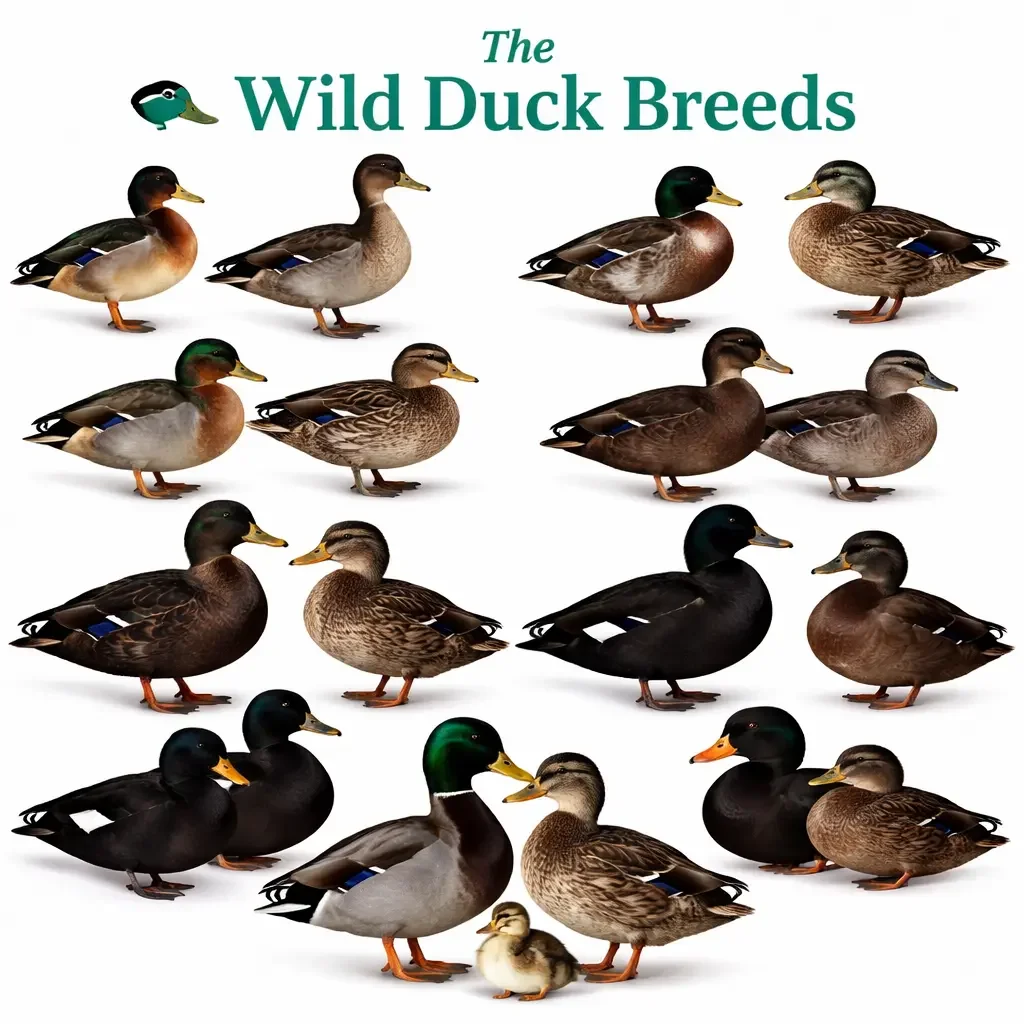
27 individual wild duck guides are now live. From the humble Bufflehead to the legendary Canvasback, from the wary American Black Duck to the colorful Wood Duck, hundreds of hours of research, writing, and field knowledge are now organized into one of the most complete wild duck libraries built for the Midwest homesteader and waterfowl hunter. Here is a look at every species we covered and why each one earned its place in the directory.
The Wild Duck Breeds section has been months in the making. Every guide follows the same standard: species overview and identification, hunting season and timing, where to hunt, difficulty rating, decoys and calling, meat quality and best preparations, behavior and biology, climate and range, homestead suitability and pond management, pros and cons, profitability notes, comparison with related species, a full FAQ, and a final verdict. No filler. No generic wildlife pamphlet content recycled from other sources.
You can browse the full library here: simitiannest.com/ducks
Below is a look at all 27 species, organized alphabetically, with a summary of what makes each one worth knowing.
WILD DUCK BREEDS
American Black Duck
One of the most challenging and storied birds in North American waterfowl hunting, the American Black Duck is the eastern counterpart to the Mallard in both genetics and ecology, but worlds apart in temperament. Legendary for its extreme wariness and fast, flushing flight, it is a prestige bird among Atlantic Flyway hunters and carries a conservation story shaped by decades of population decline, intensive research, and a cautious recovery that continues to be monitored closely. For Midwest hunters, it is a prize bird that demands more patience and more refined technique than any other dabbling duck.
American Wigeon
Known to generations of hunters as the baldpate for its bold white crown, the American Wigeon is one of the most vocal and visually distinctive ducks in the mixed-bag Midwest hunt. Its clear, three-note whistle announces a flock before the birds ever come into view, and a simple wigeon whistle call on the lanyard is one of the most underused tools in the Midwest hunter's kit. Solid table fare with a clean, plant-based flavor and a generous bag limit make it a reliable and rewarding addition to any season.
Black Scoter
The smallest and most vocal of North America's three scoter species, the Black Scoter is also the only one carrying an elevated conservation status, listed as Near Threatened by the IUCN and designated a Yellow Alert Tipping Point species in the 2025 State of the Birds report. Its drake is unforgettable: entirely velvety black with a bright pumpkin-orange bill knob that identifies the bird at any distance. Its wistful, descending whistle is one of the most evocative sounds in coastal waterfowling, and its Great Lakes migration presence completes the scoter trio in the Midwest wild duck library.
Blue-winged Teal
The quintessential early-season duck of the Midwest, the Blue-winged Teal is the reason September teal seasons exist. One of the first ducks to leave the Prairie Pothole breeding grounds in late August, it is largely gone from the northern Midwest before the main duck season opens, making the early teal window a brief, fast, and uniquely productive hunting opportunity. Outstanding table fare, fast and erratic flight that challenges even experienced wing shooters, and a Midwest breeding population that rewards good habitat management make this one of the most complete entries in the series.
Bufflehead
North America's smallest diving duck and one of its most energetic, the Bufflehead is a late-season bird that punches well above its weight in terms of hunting challenge and visual appeal. Dependent on Northern Flicker cavities for nesting, it has a unique relationship with woodpecker habitat that makes it a fascinating study in ecological connectivity. Small nest boxes can attract wintering and migrating birds to managed properties, and its lively, constantly active behavior on the water makes it one of the most entertaining ducks to observe from the blind.
Canvasback
The King of Ducks. No other title in North American waterfowling carries the same weight, and no other duck has earned it more completely. The Canvasback's reputation rests on three things: the most distinctive silhouette in the air of any North American diver, a two-bird bag limit that reflects genuine conservation attention, and table fare that is unanimously ranked at the top of the wild duck hierarchy. Its flavor, shaped by wild celery and other aquatic vegetation in the Prairie Pothole breeding region, is unlike any other duck on the continent.
Cinnamon Teal
A western species with limited Midwest presence, the Cinnamon Teal is included in the series primarily as a reference and identification guide for hunters who may encounter it during western travel or who face the notoriously difficult challenge of separating it from the Blue-winged Teal, particularly in female and eclipse plumage. The rich cinnamon-red drake is unmistakable in breeding plumage, but the hen is essentially identical to a female Blue-winged Teal. Understanding the species rounds out the teal group and completes the western counterpart to the Midwest's resident blue-wings.
Common Goldeneye
Known to hunters across the northern tier as the whistler for the distinctive sound its wings produce in flight, the Common Goldeneye is a late-season diver that arrives on Midwest rivers and Great Lakes wintering areas as the temperature drops and most other ducks have moved on. Nest boxes on large lake systems can attract breeding pairs in northern portions of the range, and the drake's spectacular head-throwing courtship display is among the most elaborate of any North American waterfowl. A solid late-season hunting target with a distinctive character all its own.
Common Merganser
The largest merganser in North America and the one most consistently encountered on Midwest rivers and lakes throughout the year, the Common Merganser is the benchmark species for understanding the serrated-bill diving ducks. Its fish-based diet produces the strongest table fare of any regularly encountered duck, making it a species most hunters pass on at the blind while appreciating its role as a water quality indicator for the rivers and lakes it inhabits. Large nest boxes can attract breeding pairs to suitable river corridor properties.
Gadwall
The most underrated duck in North American waterfowl hunting, and possibly the most underrated in the world. The Gadwall's subtle gray and brown plumage hides a bird that rivals the Mallard for table quality, responds readily to standard decoy spreads, and has quietly become one of the most abundant dabblers on the continent over the past four decades. Hunters who learn to pick Gadwalls out of mixed-bag flocks and target them deliberately find a bird that is easier to hunt than a Mallard, better on the table than most divers, and available throughout the entire main season.
Greater Scaup
The larger of North America's two bluebill scaup and the one most closely associated with the Great Lakes system, the Greater Scaup has developed an unusual ecological relationship with the invasive zebra mussel that has reshaped its winter distribution across the Midwest inland waters. Managed under a combined scaup limit alongside its lesser cousin, it requires careful field identification and a working knowledge of the zebra mussel story to fully understand its place in the modern Great Lakes ecosystem.
Green-winged Teal
North America's smallest duck and its finest table fare. No other wild duck receives a more consistent top ranking from hunters, chefs, and anyone who has prepared and eaten one properly. Fast, erratic, and capable of aerial maneuvers that embarrass larger ducks, Green-winged Teal are one of the most challenging birds to hit consistently and one of the most rewarding to bring home. Their small size and concentrated flavor make them ideal for whole roasting, and their late migration means they are available throughout the main duck season in Midwest markets.
Harlequin Duck
The most visually spectacular duck in North America and the subject of one of the more unusual biological stories in the series: a bird whose skeleton so frequently shows healed fractures from the turbulent white-water streams it inhabits that biologists use broken bones as a routine aging method. Hunting is closed in the eastern population and restricted in the west, making this primarily a reference and identification guide for Midwest hunters who may encounter the species on Great Lakes winter visits or western travel.
Hooded Merganser
The smallest North American merganser and the one with the most theatrical display in waterfowl hunting: the drake's black-and-white crest fans open like a hand of cards when he courts a hen, producing one of the most instantly recognizable and visually dramatic moments available on a Midwest pond. It uses the same nest box dimensions as the Wood Duck, making it a natural co-tenant on any property managed for cavity-nesting ducks, and its presence in the bag is a reliable conversation starter at any hunting camp.
Lesser Scaup
The bluebill of the Midwest, the most commonly encountered scaup across inland waters of the region and the subject of one of waterfowl management's more puzzling unsolved conservation questions: a population decline that began in the 1980s and has never been fully explained despite decades of research. Managed under a combined scaup limit that requires field identification to apply correctly, the Lesser Scaup is a late-season diver that rewards hunters who invest time in understanding the subtle differences between the two scaup species.
Long-tailed Duck
The most acoustically distinctive duck on the Great Lakes and one of the most visually unusual, the Long-tailed Duck carries three completely different plumage patterns across its annual cycle, including the drake's extraordinary elongated central tail feathers that give the species its name. Classified as Vulnerable by the IUCN with a population in measurable decline, it is among the more conservation-sensitive species in the series. Its yodeling call carries across open water unlike any other North American duck, and its association with deep, cold Great Lakes habitat makes it a bird genuinely tied to the character of that ecosystem.
Mallard
The benchmark. The standard. The duck against which every other duck in this series is measured. The Mallard is the most abundant duck in North America, the ancestor of most domestic duck breeds, and the species every Midwest hunter knows better than any other. The Mallard guide in this series is written not as an introduction to the species but as a complete reference, covering the full breeding and migration biology, pond management strategies, the hybridization story with American Black Ducks and Mottled Ducks, and why the Mallard's familiarity has led most hunters to systematically underestimate it as a quarry.
Mexican Duck
One of North America's most taxonomically complicated ducks, the Mexican Duck spent nearly five decades classified as a Mallard subspecies before the American Ornithological Society restored its full species status in 2020 based on genomic data. It completes the Mallard super-species complex in this series alongside the American Black Duck and Mottled Duck, three regional counterparts to the Mallard that share hybridization pressure, conservation challenges, and a closely related genetic history. A southwestern species with no Midwest hunting relevance, but essential for the completeness of the complex.
Mottled Duck
The Gulf Coast counterpart to the American Black Duck, the Mottled Duck is the non-migratory resident Mallard relative of coastal Texas, Louisiana, and Florida, and the species most severely threatened by hybridization with expanding feral Mallard populations. Its one-bird daily bag limit reflects genuine population vulnerability, and its story is one of the most instructive in waterfowl conservation for understanding the risks that domestically released and feral Mallards pose to genetically distinct regional populations. A reference guide for Midwest hunters who travel to Gulf Coast markets.
Northern Pintail
If the Mallard is the benchmark, the Northern Pintail is the aristocrat. The most elegant duck in the North American sky, the Pintail's long neck, sleek profile, and the drake's extended central tail feathers produce a silhouette identifiable at distances where other species are indistinguishable shapes. Restricted to a two-bird bag limit in most seasons due to long-term population concern, it is a species that demands respectful hunting and rewards hunters who invest in understanding its wary, high-altitude approach patterns and preference for flooded agricultural fields in the migration corridor.
Northern Shoveler
The most visually polarizing duck in the Midwest bag, the Northern Shoveler's enormous spatula-shaped bill is either a source of affectionate humor or genuine puzzlement depending on who encounters it first. Its reputation as the spoonie carries a table fare stigma that is not entirely deserved, particularly for birds taken from clean freshwater habitat where the mud-sieving behavior that produces the worst flavor is minimal. Its filter-feeding biology is among the most specialized in dabbling ducks, and its willingness to work shallow, muddy habitat gives it a unique place in the Midwest hunting landscape.
Redhead
The Prairie Pothole Region's most important diving duck and a species whose conservation story is inseparable from the history of wetland drainage across the Midwest. The Redhead's habit of nest parasitism, laying eggs in other ducks' nests, is one of the more unusual reproductive strategies in North American waterfowl and has practical implications for understanding productivity monitoring. Its two-bird bag limit, warm chestnut-red head, and mid-sized profile make it one of the more distinctive and conservation-conscious hunting targets in the series.
Ring-necked Duck
The most misleadingly named duck in North America: the ring-neck refers to an obscure chestnut collar visible only in hand, while the bold white ring on the bill is the actual field mark everyone uses. The best-tasting diver in most hunters' rankings, the Ring-necked Duck uses smaller ponds and shallower water than most diving ducks, making it one of the few divers that managed farm ponds and homestead water features can attract during migration. Wild rice and aquatic vegetation in its diet produce a cleaner, milder flavor than its fellow divers.
Ruddy Duck
The most unusual duck in the Midwest hunting landscape: a stiff-tailed, deep-diving species that sits low in the water, holds tight under pressure, and carries one of the most recognizable breeding plumages of any North American waterfowl with its sky-blue bill and rich chestnut body. Its poor reputation as table fare is well established, its flight is lethargic compared to most ducks, and its association with the Prairie Pothole breeding region makes it an important indicator species for wetland health across the Midwest.
Surf Scoter
The skunkhead coot of coastal waterfowling culture, the Surf Scoter's bold white forehead and nape patches on an otherwise black body, combined with a large multicolored bill and icy white eyes, produce one of the most striking profiles of any sea duck. An exclusively North American breeding species and the most common of the three scoters, it appears on the Great Lakes during fall migration and is the second entry in the scoter trio. Its population has declined 50 to 70 percent over 40 years under causes that remain incompletely understood, giving it a conservation dimension worth knowing.
White-winged Scoter
The largest sea duck in North America and the anchor of the Great Lakes scoter hunting season, the White-winged Scoter has grown in inland importance as its Great Lakes wintering numbers have increased in response to the spread of invasive zebra mussels. Its bold white wing patches, visible in flight at significant distance, make it the most identifiable of the three scoters, and its courtship displays, which include drakes flying upside down during aerial group performances, are among the most spectacular of any North American waterfowl. The first and most important scoter entry in the Midwest wild duck library.
Wood Duck
The most visually stunning duck in North America and the conservation comeback story that changed how Americans think about wildlife management. The Wood Duck was pushed to the edge of extinction by the early twentieth century through unregulated market hunting and the loss of old-growth timber that provided natural nesting cavities. The nest box program that followed became one of the most successful waterfowl recovery efforts in history and a model still used today. Installing a Wood Duck nest box on any Midwest pond or wetland with appropriate tree cover is one of the highest-return habitat investments a homesteader can make.
27 guides. Every major wild duck species of the Midwest and beyond.
Every one researched, written, and built to the same standard as everything else on this site. The Wild Duck Breeds section is now one of the most complete Midwest waterfowl libraries available, covering not just hunting tips and identification but pond management, homestead suitability, conservation status, table fare, and the biology that makes each species worth understanding on its own terms. Building it has been one of the most rewarding projects on this site so far.
The series will keep growing. Domestic ducks, domestic geese, and wild geese are all coming. If there is a species you want covered first, leave a comment below.
Browse the full Duck Breeds section here: simitiannest.com/ducks
Happy Growing!